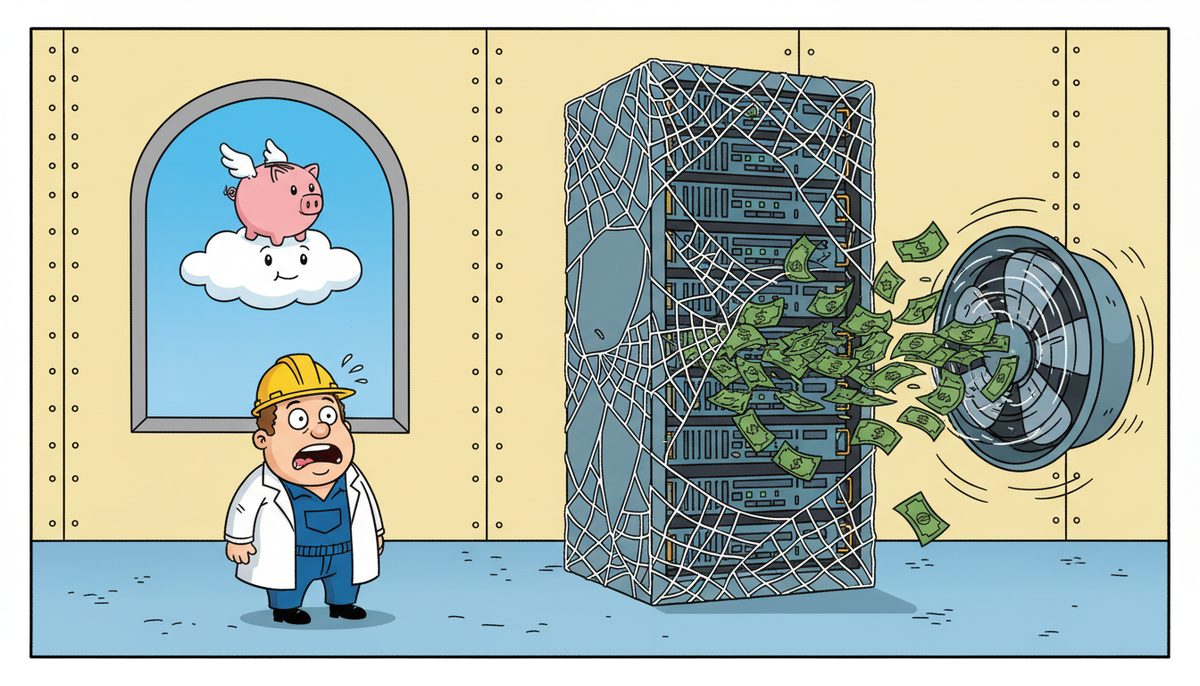
Cloud infrastructure reduces manufacturing IT costs by 30-40% by eliminating upfront hardware purchases, cutting energy and cooling expenses, and converting fixed capital expenditures into predictable operational costs. You pay only for the storage and computing power you actually use, scaling resources up during peak production periods and down during slower months without maintaining expensive on-premise servers year-round.
What upfront costs does cloud infrastructure eliminate?
Traditional on-premise infrastructure requires substantial capital investment before you process a single work order. A production-grade server costs $8,000-$25,000, plus backup systems, uninterruptible power supplies, network switches, and rack equipment. Installation and configuration add another $3,000-$8,000 in professional services.
Cloud infrastructure removes these barriers entirely. You access enterprise-grade computing resources immediately without purchasing hardware. Your ERP system, CAD/CAM software, and production scheduling tools run on infrastructure maintained by the provider, not sitting in your facility consuming space and requiring climate control.
For Vancouver Island manufacturers, this elimination of upfront costs is particularly valuable. Island geography means equipment shipments face ferry delays and higher freight costs. When a server fails, replacement parts take days to arrive from the mainland. Cloud infrastructure sidesteps these logistical challenges completely.
The capital you would have locked into depreciating servers stays available for production equipment, inventory, or facility improvements that directly generate revenue.
How much do I save on energy and facilities costs?
On-premise servers consume power continuously, generating heat that requires additional cooling. A typical rack-mounted server draws 500-1,200 watts around the clock. At BC Hydro’s commercial rates, that’s $400-$1,000 annually per server just for electricity, before accounting for the air conditioning needed to prevent overheating.
Manufacturing facilities on Vancouver Island often lack dedicated server rooms with proper environmental controls. You’re either cooling your entire shop floor to protect IT equipment or installing separate HVAC systems for a small equipment closet—both inefficient approaches that inflate utility bills.
Cloud infrastructure shifts these costs to providers who achieve massive economies of scale. Hyperscale data centers operate at power usage effectiveness ratios of 1.1-1.2, meaning nearly all electricity goes to computing rather than cooling. You benefit from this efficiency without the engineering expertise or investment required to achieve it yourself.
A mid-sized manufacturer saves $3,000-$7,000 annually in combined electricity and cooling costs by moving to cloud infrastructure.
You also reclaim valuable floor space. Server equipment occupies room that could house production machinery, inventory, or workstations. For manufacturers operating in Victoria or Duncan where industrial space commands premium rates, this recovered square footage has real financial value.
How does pay-as-you-grow pricing reduce waste?
Traditional IT infrastructure forces you to overprovision. You purchase server capacity for peak demand, then watch most of that investment sit idle during normal operations. A manufacturer preparing for seasonal production increases might buy a $15,000 server that runs at 30% capacity eight months of the year.
Cloud infrastructure charges based on actual consumption. Storage scales with your bill of materials database size. Computing power adjusts to match production scheduling complexity. During your busy season serving export orders through Victoria’s port, you provision additional resources. When production slows, you scale back and your costs decrease proportionally.
This elasticity prevents two costly scenarios. You never pay for unused capacity sitting dormant in your facility. You also never hit performance ceilings that force emergency hardware purchases during critical production periods.
For manufacturers running MES or SCADA systems that generate variable data volumes, this flexibility is particularly valuable. Quality control initiatives that increase sensor data collection don’t require new storage arrays. You simply consume more cloud storage at incremental cost.
The predictability matters as much as the flexibility. Cloud services like managed IT services cost [OWNER: need official pricing range for managed IT services per user per month], with cloud backup running [OWNER: need official pricing range for cloud backup per user monthly]. These consistent operational expenses simplify budgeting compared to unpredictable hardware replacement cycles.
What maintenance and staffing costs disappear?
On-premise infrastructure demands ongoing maintenance that consumes time and money. Servers require firmware updates, security patches, and periodic hardware refreshes. Storage arrays need capacity monitoring and expansion planning. Backup systems require testing to ensure recovery actually works when production lines go down.
Someone must perform this work. Smaller manufacturers rarely employ full-time IT staff, so production managers or administrative personnel handle technology tasks alongside their primary responsibilities. Larger operations hire dedicated technicians at $50,000-$75,000 annually plus benefits, or contract IT support in Victoria at hourly rates for reactive break-fix services.
Cloud infrastructure transfers these responsibilities to the provider. Security patches apply automatically. Capacity expands without your intervention. Redundancy and failover happen behind the scenes. The infrastructure team monitoring your systems works for the cloud provider, not your payroll.
This shift is particularly valuable for Vancouver Island manufacturers where specialized IT talent is scarce. The island’s smaller technology sector means fewer qualified technicians understand both manufacturing systems and enterprise IT. Cloud providers employ teams with deep expertise that would be prohibitively expensive to hire directly.
Daryl from construction captured this peace of mind: “Considering all the cyber threats facing businesses today, you have to ask, what happens if your systems go down and you can’t operate for several days? If this would cause you big problems, I’d suggest protecting yourself by selecting DataStream as your security partner and get some peace of mind knowing they have it covered.”
The same principle applies to infrastructure. When your cloud provider handles maintenance, monitoring, and security, you redirect internal resources toward production optimization rather than keeping servers running.
How does cloud infrastructure reduce downtime costs?
Production downtime in manufacturing carries severe financial consequences. Every hour your ERP system is unavailable, work orders stall, inventory tracking fails, and shipping documentation stops. For just-in-time operations, even brief outages cascade into missed delivery commitments and penalty clauses.
On-premise infrastructure creates single points of failure. A failed server means downtime until a technician arrives, diagnoses the problem, and either repairs or replaces the hardware. On Vancouver Island, this response cycle extends due to geography. Replacement parts ship from Vancouver or further. Specialized technicians may need to ferry from the mainland. What might be a four-hour fix in a major city becomes a multi-day crisis.
Cloud infrastructure builds in redundancy at every level. Your data replicates across multiple physical locations. If one server fails, traffic routes automatically to healthy systems. Storage systems distribute data across numerous drives so individual failures don’t interrupt access. This enterprise-grade reliability would cost hundreds of thousands to replicate on-premise.
The financial impact is measurable. If production downtime costs your operation $5,000 per hour in lost output and labor, and cloud infrastructure prevents just two four-hour outages annually, you’ve saved $40,000. That single benefit often exceeds the entire year’s cloud infrastructure cost.
Cloud-based managed IT services for manufacturing in Victoria combine infrastructure reliability with rapid response. When issues do occur, technicians can often resolve problems remotely within minutes rather than dispatching to your facility, minimizing production impact.
What about disaster recovery and business continuity savings?
Adequate disaster recovery for on-premise infrastructure requires duplicate systems in a separate location. You need backup servers, storage, and network equipment at a secondary site, plus the connectivity to replicate data continuously. This redundancy effectively doubles your infrastructure investment.
Most small to mid-sized manufacturers can’t justify this expense. They rely instead on local backups—tape drives or external hard drives stored on-site. When disaster strikes, whether fire, flooding, or equipment theft, both production systems and backups are lost simultaneously. Recovery becomes a weeks-long process of rebuilding from scratch.
Cloud infrastructure includes geographic redundancy by default. Your production data replicates to data centers in different regions automatically. If your Victoria facility becomes inaccessible, you can restore operations from Nanaimo, Duncan, or even temporarily from home offices. The infrastructure supporting your business exists independently of your physical location.
This capability matters particularly for Vancouver Island manufacturers. The island faces earthquake risk from the Cascadia Subduction Zone. Facilities in low-lying areas near Victoria’s harbor face flood exposure. Any disaster that impacts your building doesn’t affect your data or systems when they’re cloud-hosted.
The cost comparison is stark. Building redundant on-premise disaster recovery might cost $30,000-$100,000 in duplicate hardware and secondary site preparation. Cloud backup services provide superior protection at a fraction of the capital investment.
Cloud infrastructure transforms disaster recovery from an expensive luxury into an affordable standard practice, protecting your business without breaking your budget.
How do I calculate my actual cloud infrastructure savings?
Start by inventorying your current IT infrastructure costs across all categories. Include obvious expenses like server purchases and software licenses, but also hidden costs: electricity consumption, cooling, floor space, maintenance contracts, and the time your staff spends on IT tasks rather than their primary roles.
Calculate your total cost of ownership over a three-year period. On-premise infrastructure requires replacement or major upgrades every 3-5 years, so this timeframe captures the full lifecycle. Add hardware purchases, installation, energy costs, maintenance, and the fully-loaded cost of staff time dedicated to IT management.
Compare this to cloud infrastructure pricing for equivalent capacity. For a 15-person manufacturing operation, monthly costs typically total [OWNER: need example monthly cost range for 15-person operation], or [OWNER: need 3-year total based on monthly range] over three years.
On-premise infrastructure for the same operation might include:
- $25,000 in servers and storage
- $8,000 in networking equipment
- $5,000 in installation
- $15,000 in electricity and cooling over three years
- $12,000 in maintenance contracts
- $30,000 in staff time
This totals approximately $95,000, assuming no major failures, no emergency replacements, and no downtime costs.
When you factor in realistic failure rates and downtime costs, cloud infrastructure delivers 20-40% total cost of ownership savings while providing superior reliability and eliminating capital expenditure.
For Vancouver Island manufacturers, add the value of eliminating ferry-delay logistics for hardware shipments and the premium of accessing specialized IT expertise locally through providers who maintain technicians in Victoria, Nanaimo, and Duncan rather than requiring mainland travel for on-site support.
The calculation becomes even more favorable when you account for opportunity cost—the productive uses for capital that would otherwise lock into depreciating server hardware.
Frequently asked questions
Does cloud infrastructure work for manufacturing with SCADA and PLC systems?
Yes, though industrial control systems often use hybrid approaches. Your SCADA and PLC systems typically remain on-premise for real-time machine control, while ERP, CAD/CAM, production scheduling, and business systems run in the cloud. This separation maintains the millisecond response times industrial equipment requires while moving business applications to more cost-effective cloud infrastructure. Data flows between systems through secure connections.
What happens to my cloud data if I stop paying or switch providers?
Reputable cloud providers include data portability in their contracts. You can export your complete dataset in standard formats before terminating service. Most providers offer 30-60 day grace periods after contract end to retrieve data. Always verify export capabilities and backup procedures before committing to a cloud provider. Maintain your own periodic exports of critical production data as an additional safeguard against any provider issues.
How does cloud infrastructure handle compliance with PIPEDA and BC PIPA?
Cloud providers serving Canadian manufacturers typically offer data residency options that keep information within Canada, satisfying provincial and federal privacy requirements. Verify that your provider’s data centers are located in Canada and that contracts specify data won’t transfer across borders without consent. The provider handles physical security and access controls, while you remain responsible for appropriate data governance policies and user access management within your organization.
Can cloud infrastructure scale fast enough for sudden production increases?
Cloud infrastructure scales in minutes rather than the weeks or months required to procure, ship, and install physical servers. When you land a large contract requiring additional production capacity, your IT systems expand immediately to support increased work orders, inventory tracking, and shipping documentation. You provision additional storage, computing power, or user licenses through a web portal, and resources become available almost instantly without capital expenditure or installation delays.
What internet speed do I need for cloud infrastructure in manufacturing?
Most manufacturing operations function well with 50-100 Mbps internet connections, sufficient for ERP access, CAD file transfers, and production reporting. Facilities with extensive video surveillance, large CAD/CAM file transfers, or real-time production monitoring may benefit from 100-250 Mbps. Vancouver Island manufacturers should ensure redundant internet connections from different providers to prevent single points of failure, since cloud infrastructure depends on reliable connectivity for access to business-critical systems.