
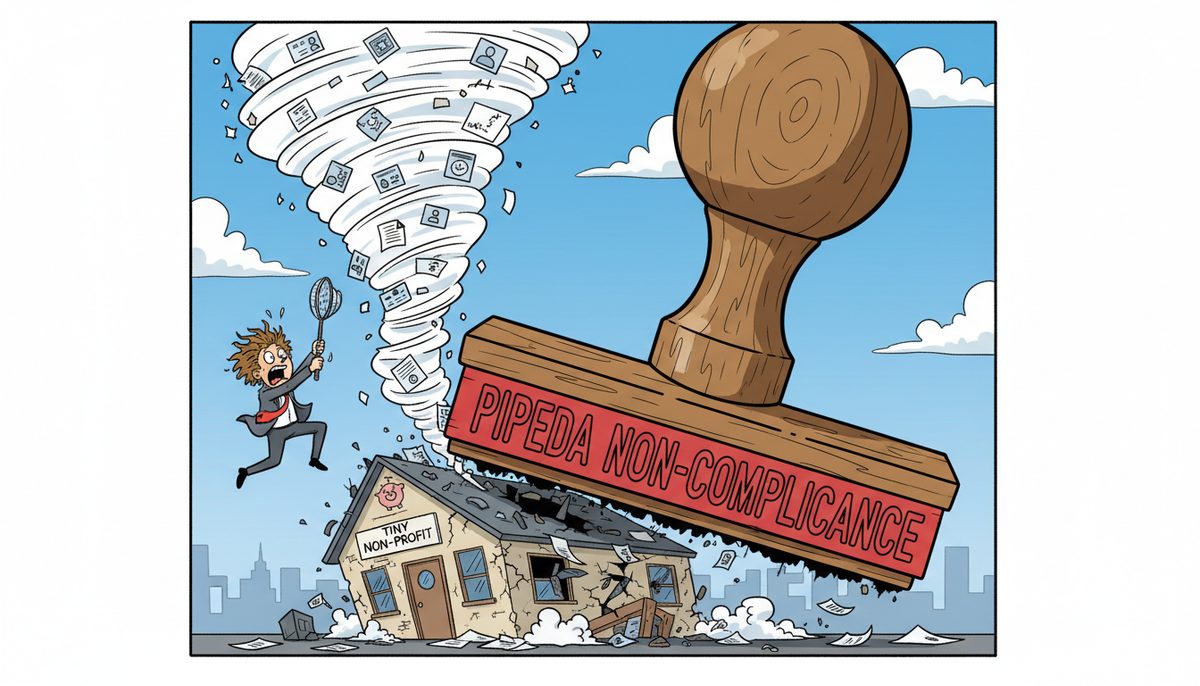
When your nonprofit fails PIPEDA compliance in BC, you face mandatory breach reporting to the Privacy Commissioner within 72 hours, potential fines up to $100,000 per violation, CRA audits that can threaten charitable status, and immediate donor trust erosion that impacts fundraising for years. BC’s PIPA legislation adds stricter provincial requirements for organizations handling BC resident data.
What triggers a PIPEDA compliance failure for nonprofits?
A compliance failure occurs when your organization collects, stores, or uses donor or beneficiary personal information without proper consent, adequate security safeguards, or documented policies. This includes credit card data from online donations, beneficiary health information, volunteer background checks, and program participant records.
The most common trigger is a data breach—when unauthorized parties access your systems. Your donor management system gets compromised, a laptop containing beneficiary files is stolen, or an email account with donation records gets hacked. The moment you become aware of a breach involving personal information, the compliance clock starts ticking.
Breaches aren’t the only trigger. Privacy Commissioner investigations can start from donor complaints about how you’re using their information, unsecured donation forms on your website, or failure to respond to access requests. When a donor asks what information you hold about them and you can’t produce records within 30 days, that’s a compliance failure.
BC Gaming grant recipients face additional scrutiny because gaming funds require specific financial record-keeping standards. If your systems can’t demonstrate proper data handling for restricted grant funds, you risk both privacy violations and grant eligibility.
The villain here is treating donor data casually because you’re mission-focused, not a commercial business—assuming privacy laws don’t apply as strictly to charities.
What are the immediate legal consequences you face?
The 72-hour mandatory breach notification requirement hits first. You must report to the Privacy Commissioner of Canada any breach involving personal information that poses a “real risk of significant harm” to individuals. Miss that deadline and penalties escalate immediately.
Federal penalties under PIPEDA can reach $100,000 per violation for organizations that fail to comply with Commissioner orders.
BC’s PIPA adds provincial penalties that can stack on top of federal ones. Your organization operates under whichever law is stricter for the data you’re handling. Since most Vancouver Island nonprofits serve BC residents, PIPA’s requirements typically govern your obligations.
You’re also required to notify affected individuals directly when their information is compromised. That means contacting every donor whose credit card data was exposed, every beneficiary whose health information leaked, every volunteer whose background check was accessed. The notification must explain what happened, what data was involved, and what steps you’re taking.
CRA gets involved when compliance failures affect your charitable status requirements. Registered charities must maintain proper books and records. If a breach destroys donation records or you can’t produce required documentation during an audit because systems failed, CRA can suspend tax receipting privileges or revoke charitable registration entirely.
Legal liability extends to civil lawsuits. Donors and beneficiaries whose information was mishandled can sue for damages. Your directors and officers may face personal liability if the breach resulted from governance failures—not having policies in place, ignoring known risks, or failing to allocate resources to data protection.
How does a compliance failure destroy donor relationships?
The financial penalties hurt, but the trust damage kills your mission funding. When donors learn their credit card information was exposed because your donation system wasn’t secured, they stop giving. Not just to you—they become wary of all online nonprofit donations.
Your year-end campaign collapses. December donations typically represent 30-40% of annual individual giving for Canadian charities. A November breach means your critical fundraising window closes just as donors receive notification letters explaining what went wrong.
Major donors and foundations ask pointed questions. United Way and community foundation grant applications now require cybersecurity attestations. When you can’t honestly complete those sections after a compliance failure, restricted funding disappears. Foundations talk to each other—word spreads quickly in Victoria’s concentrated nonprofit sector.
Monthly donors cancel their recurring gifts. These supporters represent your most reliable revenue stream, often covering core operating costs. Losing them means cutting programs immediately because you can’t meet payroll or rent.
Your board faces uncomfortable conversations. Volunteers who joined to advance your mission suddenly spend meetings discussing legal liability, insurance claims, and damage control instead of program impact. Good board members resign rather than accept the personal risk.
The philosophical wrong here cuts deep: people trusted you with their information specifically because you’re a charity serving the community. Violating that trust feels like a betrayal of your mission itself.
What operational chaos follows a compliance failure?
Your daily operations grind to a halt while you manage the crisis. Staff who should be delivering programs spend weeks responding to donor inquiries, coordinating with lawyers, and rebuilding systems. Program delivery suffers exactly when beneficiaries need you most.
You’re forced to hire external forensic investigators to determine breach scope. Legal counsel bills pile up as you navigate notification requirements, Privacy Commissioner responses, and potential lawsuits. These costs come directly from operating reserves meant for mission work.
Your donor management system might be taken offline during investigation, meaning you can’t process new donations, issue tax receipts, or communicate with supporters. During your busiest fundraising season, you’re essentially closed for business.
Grant reporting deadlines don’t pause for your crisis. BC Gaming requires quarterly financial reports. Community foundations expect program outcome data. When your systems are compromised or offline, you miss deadlines and risk losing funding for programs already underway.
Insurance premiums spike after a claim. Many nonprofits discover their general liability policies don’t cover cyber incidents. Cyber insurance, if you can still get it, costs significantly more after a breach. Some organizations become uninsurable.
Staff morale collapses. Your team joined a nonprofit for mission impact, not to manage technology disasters. Key employees leave for more stable organizations. Recruiting replacements becomes harder when your breach is public knowledge.
Volunteer recruitment suffers. People hesitate to volunteer when they’re not confident their personal information will be protected. Your volunteer base—already stretched thin across Victoria’s nonprofit sector—shrinks further.
How do you actually achieve and maintain PIPEDA compliance?
Compliance starts with understanding what personal information you actually hold. Audit every system: your donor management database, email accounts, volunteer files, program participant records, and financial systems. Document what data you collect, why you need it, where it’s stored, and who can access it.
Implement the ten fair information principles that form PIPEDA’s foundation. Get meaningful consent before collecting information—not buried in fine print, but clear explanation of what you’re collecting and why. Limit collection to what’s actually necessary for donation processing or program delivery. Use the information only for stated purposes.
Secure the data appropriately. Encrypt donor credit card information. Require strong passwords and multi-factor authentication for anyone accessing sensitive systems. Ensure your donation platform and donor management system use current security standards. Back up data reliably so you can recover from incidents without losing critical records.
Create written policies that document your privacy practices. Your privacy policy should explain to donors and beneficiaries what information you collect, how you use it, how long you keep it, and how they can access or correct their information. Train staff and volunteers on these policies.
Establish breach response procedures before you need them. Know who to contact, how to assess breach severity, and how to execute notification requirements within the 72-hour window. Having a plan means you respond effectively instead of panicking.
Review third-party vendors. If you use cloud-based donor management systems, email marketing platforms, or payment processors, ensure they have appropriate security measures and contractual data protection obligations. You remain responsible even when vendors handle data on your behalf.
Conduct regular privacy impact assessments, especially when implementing new programs or systems. Before launching a new beneficiary intake process or switching donor platforms, evaluate privacy implications and build protections into the design.
When you’re managing all this without IT staff, the technical requirements feel overwhelming alongside your mission work.
When does expert help protect your mission and compliance?
You need expert help when the technical requirements exceed your team’s capacity to implement them correctly while still delivering programs. Most Vancouver Island nonprofits don’t have IT staff. Your office manager or executive director is trying to handle technology alongside their actual job.
The right support understands both the technology and the nonprofit context. You need someone who knows that when your donor system goes down three days before your year-end mail drop, that’s not just an IT problem—it’s a mission crisis threatening the revenue that funds next year’s programs.
Local Vancouver Island support matters specifically for compliance because mainland providers involve ferry delays during time-sensitive situations. When you discover a potential breach and need immediate assessment to determine if you’re within the 72-hour reporting window, waiting for a technician to catch the ferry from Vancouver isn’t acceptable.
Chris Elder, working in professional services, experienced this kind of responsive support: “We hired DataStream to manage our small business IT needs and Lucius and his team has been a pleasure to deal with every step of the way. He is professional and very responsive to our needs and would recommend DataStream to any business that wants to ensure their IT systems are up to date and running smoothly.”
Since 2012, local Vancouver Island technicians have helped organizations navigate the specific challenges nonprofits face with limited budgets and high-stakes data protection needs. When you call, you talk to a real local technician immediately—no voicemail or phone trees—who can assess your compliance gaps and fix technical vulnerabilities remotely within minutes in most cases.
Technicians in Victoria, Nanaimo, Duncan, and Cobble Hill understand BC’s PIPA requirements, CRA record-keeping standards for registered charities, and BC Gaming grant compliance needs. If remote resolution isn’t possible, a technician is automatically dispatched to your location without ferry delays.
Support options include managed IT services that monitor your systems proactively, implement security updates before vulnerabilities become breaches, and maintain the backup systems that let you recover donor records after incidents. For organizations needing assessment before building compliance programs, gap analysis services identify specific vulnerabilities in your current setup.
Three steps to move from compliance risk to confidence
- Call (250) 929-0745 to talk with a real Victoria technician who understands nonprofit technology and compliance requirements—explain your current setup, donor systems, and specific concerns about data protection.
- Get a clear assessment of your compliance gaps and vulnerabilities, with practical recommendations prioritized by risk level and your budget reality, so you know exactly what needs to be fixed first.
- Implement the technical safeguards, backup systems, and monitoring that protect donor data and meet PIPA requirements, with ongoing support from local technicians who answer immediately when you need help.
What does success actually look like for your nonprofit?
Success means processing December donations smoothly, knowing donor credit card data is encrypted and secure. Your year-end campaign runs without technology anxiety. Tax receipts generate automatically from systems that are backed up and compliant.
You submit grant applications confidently, completing cybersecurity attestations honestly because your systems actually meet the standards United Way and community foundations require. You win restricted funding that competitors can’t access because they can’t demonstrate data protection.
When CRA audits your charitable status, you produce required digital records immediately from reliable backup systems. The audit confirms compliance instead of threatening your registration. Your board focuses on mission strategy instead of crisis management.
Your donors trust you with monthly gifts because they’re confident their information is protected. Major donors increase giving because your professionalism extends to data stewardship, not just program delivery. Foundation officers recommend you to their peers as a well-managed organization.
You sleep soundly knowing that if a breach attempt occurs, monitoring systems catch it immediately and your response plan executes within the 72-hour window. You’re protected legally, operationally, and reputationally.
Your staff focuses on mission work instead of technology fires. Programs expand because operating reserves aren’t diverted to emergency IT costs. You recruit excellent employees and volunteers because your organization is stable and trustworthy.
If you’re handling donor data without confidence that your systems meet PIPEDA and PIPA requirements, call (250) 929-0745 now to talk with a Victoria technician who can assess your specific situation and fix vulnerabilities before they become breaches. You’ll speak with a real person immediately—no voicemail—who understands nonprofit compliance needs on Vancouver Island.
For organizations across Vancouver Island needing IT support in Victoria, Nanaimo, or Duncan, local technicians provide the fast response times that matter during compliance-critical situations.
Frequently asked questions
Does PIPEDA apply to small nonprofits or only large charities?
PIPEDA applies to any organization conducting commercial activities, including nonprofits that collect donations, sell goods or services, or handle personal information during any commercial transaction. Size doesn’t matter—if you process credit card donations online or maintain a donor database, you’re subject to PIPEDA requirements. BC nonprofits also fall under PIPA, which often has stricter standards for provincial resident data regardless of organization size.
What’s the actual deadline for reporting a data breach?
You must report breaches to the Privacy Commissioner of Canada as soon as feasible after determining that a breach poses a real risk of significant harm to individuals, which typically means within 72 hours of discovery. You must also notify affected individuals and keep records of all breaches, even those not requiring notification. BC’s PIPA has similar timing requirements for provincial reporting.
Can we lose charitable status over a privacy compliance failure?
Yes. CRA can revoke charitable registration if compliance failures prevent you from maintaining proper books and records as required for registered charities. If a breach destroys donation records, you can’t issue valid tax receipts, or you can’t produce documentation during audits, CRA may suspend receipting privileges or revoke registration entirely, ending your ability to issue charitable tax receipts that donors need.
What counts as adequate security safeguards for donor data?
Adequate safeguards are proportional to the sensitivity of information and breach risk. At minimum: encrypt credit card data and sensitive beneficiary information, require strong passwords and multi-factor authentication for system access, maintain current security updates on all devices, implement reliable backup systems, restrict data access to only those who need it, and train staff on security practices. Cloud systems must meet recognized security standards.
Do we need cyber insurance to be PIPEDA compliant?
PIPEDA doesn’t specifically require cyber insurance, but it does require appropriate safeguards and breach response capability. Insurance doesn’t replace compliance—you still need proper security measures, policies, and procedures. However, insurance can help cover breach notification costs, legal fees, forensic investigation, and potential liability claims that follow compliance failures. Many grant funders now ask about cyber insurance as evidence of risk management.
How much does it cost to achieve PIPEDA compliance for a nonprofit?
Costs vary based on your current systems, data volume, and complexity. Initial gap analysis and policy development typically ranges from $2,500–$10,000 for assessment and $1,500–$7,500 for documentation. Ongoing technical safeguards include backup systems ($40–$150 per device monthly), security protection ($40–$100 per device monthly), and managed IT support ($150–$225 per user monthly) that maintains compliance. Many nonprofits start with critical fixes first, building comprehensive compliance over time as budget allows.