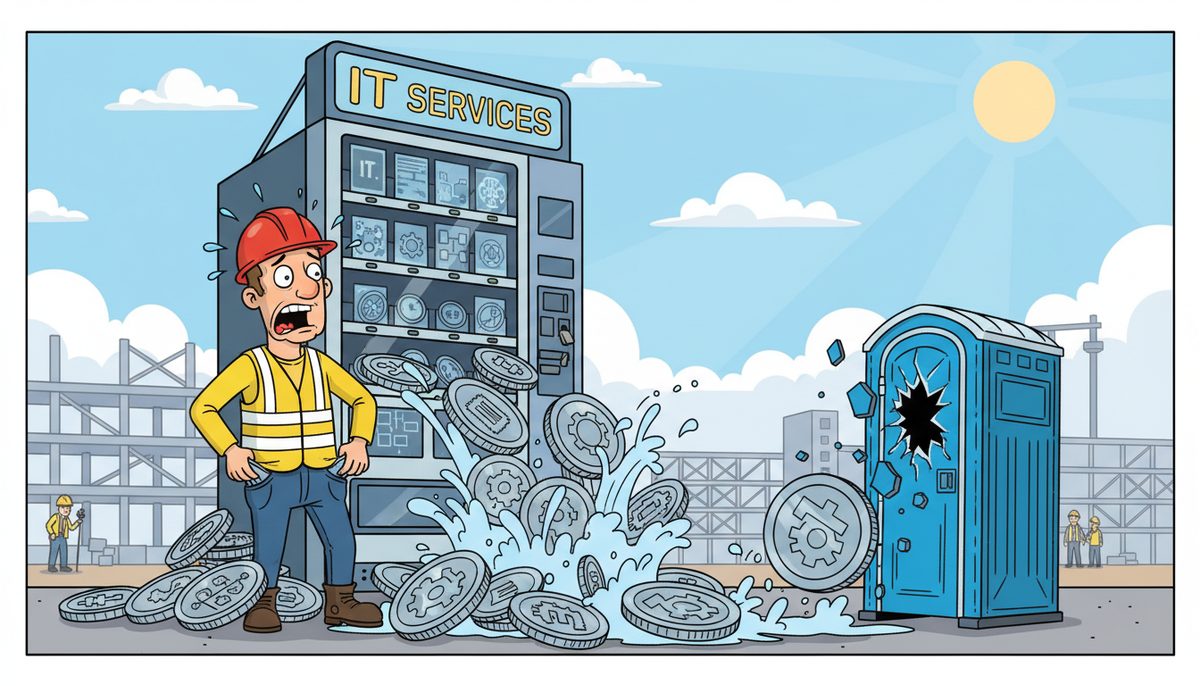
Co-managed IT services for small businesses in Victoria typically cost between $150 and $225 per user per month for comprehensive managed IT services. Additional cybersecurity protection adds $25–$50 per device monthly, while specialized services like mailbox protection ($5–$15 per user/month) and cyber awareness training ($5–$15 per user/month) provide layered security. A five-person office typically invests $1,000–$1,625 monthly for complete co-managed IT with cybersecurity protection.
What does co-managed IT include for the price?
Co-managed IT means your internal team or existing IT person handles day-to-day operations while a managed service provider like DataStream Networks backs them up with specialized expertise, after-hours support, and strategic guidance. You’re not replacing your IT staff—you’re extending their capabilities.
The base managed IT service typically covers help desk support, proactive network monitoring, patch management, and regular system maintenance. For construction companies in Victoria, this means your estimating software, project management platforms, and document systems stay operational when you need them most—especially before bid deadlines.
DataStream’s co-managed model includes live phone support answered by real people, not voicemail systems. When your project manager can’t access critical drawings an hour before a submittal deadline, you reach a local Vancouver Island technician who understands your urgency.
Security components add another layer. The cybersecurity suite ($25–$50 per device/month) provides endpoint protection, threat detection, and vulnerability management. Mailbox protection ($5–$15 per user/month) filters phishing attempts that target construction companies with fake supplier invoices or fraudulent payment requests.
Co-managed IT gives you flexibility: your team handles routine tasks while experts manage complex security, compliance documentation for WorkSafeBC reporting, and disaster recovery planning.
How does pricing scale for construction companies?
Construction firms typically calculate costs per office user, not per field worker. A Victoria general contractor with five office staff (project managers, estimators, admin) and twenty field workers would budget for five users at $150–$225 each monthly, totaling $750–$1,125 for managed IT services.
Device-based pricing applies to all computers, servers, and mobile devices accessing company systems. That same contractor might protect ten devices (office computers, superintendent laptops, tablets for site documentation) at $25–$50 per device, adding $250–$500 monthly for comprehensive cybersecurity.
The math changes with your structure. A residential builder with three office staff might spend $450–$675 monthly for managed IT plus $150–$300 for device security. A larger commercial contractor with fifteen office users could invest $2,250–$3,375 for IT management plus cybersecurity costs.
Luigi Mansueti, a Victoria construction professional, worked with DataStream when systems were running slow: “DataStream installed a new backup system, provided security for our network, and established a roadmap for future projects. DataStream thoroughly cleaned our file sharing, implemented password control, and smoothly transitioned us to take back control of our network.” His systems no longer run slow, and he regained network control—outcomes that justify the investment when bid preparation and project coordination depend on reliable technology.
Seasonal fluctuations matter less than you’d expect. Most providers charge based on your established user count, not daily headcount variations. Adding temporary staff for a large project typically doesn’t require immediate plan changes unless they need full system access.
A five-person construction office in Victoria typically invests $1,000–$1,625 monthly for complete co-managed IT with cybersecurity protection.
What factors increase or decrease co-managed IT costs?
Your existing infrastructure significantly impacts pricing. Companies with newer equipment, organized file systems, and documented processes cost less to support than those running outdated servers, chaotic data storage, or unsupported software versions. The initial cleanup and standardization work happens upfront, then monthly costs stabilize.
Geographic spread affects service delivery. Construction companies operating across Vancouver Island—with offices in Victoria, job sites in Nanaimo, and projects in Duncan—benefit from DataStream’s local technician presence in these communities. When remote support can’t resolve an issue, on-site dispatch happens quickly without travel surcharges from mainland providers.
Compliance requirements add complexity. Projects involving BC government contracts fall under the Freedom of Information and Protection of Privacy Act (FIPPA), requiring enhanced data security and access controls. Heritage building renovations demand extensive digital documentation with secure backup systems. These specialized needs may push costs toward the higher end of pricing ranges.
Your risk tolerance matters. Companies satisfied with basic protection choose foundational services. Those recognizing the reality Daryl Wood, a construction industry client, articulated—”Considering all the cyber threats facing businesses today, you have to ask, what happens if your systems go down and you can’t operate for several days?”—invest in comprehensive security. Wood selected DataStream as his security partner for “peace of mind knowing they have it covered.”
Response time expectations influence costs. Standard business-hours support costs less than 24/7 coverage. Construction companies bidding on time-sensitive tenders often need after-hours support when estimators work late to meet submission deadlines.
The co-managed model itself reduces costs compared to fully managed IT. You’re paying for expert backup and specialized services, not complete technology management. Your internal person handles password resets and printer issues while the managed provider tackles security threats, complex network problems, and strategic planning.
How does co-managed IT compare to hiring full-time IT staff?
A full-time IT professional in Victoria earns $55,000–$75,000 annually plus benefits, vacation coverage, and training costs. That translates to $5,000–$7,000 monthly for one person with one skill set, limited availability, and no backup when they’re sick or on vacation.
Co-managed IT at $1,000–$1,625 monthly for a five-person office provides access to an entire team with diverse expertise: network specialists, security analysts, backup experts, and help desk technicians. You gain depth across multiple technology domains without the overhead of employment.
The hybrid approach works well for growing construction companies. Keep your IT-savvy office manager or junior technician handling routine tasks and user support. Add co-managed IT services for specialized knowledge they lack: configuring firewall rules, implementing BC Builders Lien Act-compliant document retention, or recovering data after a ransomware attempt.
Coverage becomes seamless. DataStream answers phones with live people—no voicemail, phone tree, or long wait times. When your internal person is at a job site helping set up a site office network, the managed provider handles support calls. Most problems get fixed remotely within minutes.
Consider the scenario: your estimator’s computer crashes Tuesday morning with a bid due Thursday. Your internal IT person is troubleshooting a server issue. With co-managed support, a second technician immediately helps the estimator while your person continues the server work. Without that backup, you’re choosing which crisis to address first.
For small construction companies, co-managed IT delivers enterprise-level support at small-business pricing.
What should Victoria construction companies budget beyond monthly fees?
Monthly service fees cover ongoing support, monitoring, and maintenance. One-time costs appear during initial setup and periodic infrastructure upgrades. Budget for these separately to avoid surprises.
Onboarding typically includes network assessment, security hardening, backup system configuration, and documentation creation. Providers may charge setup fees ranging from one month’s service cost to several thousand dollars depending on your current state. Companies with well-maintained systems pay less than those requiring extensive cleanup.
Hardware replacement follows predictable cycles:
- Computers last 4-5 years
- Servers last 5-7 years
- Network equipment lasts 5-8 years
A construction company with ten computers should budget $10,000–$15,000 every four years for workstation refresh, or roughly $200–$300 monthly if you’re planning ahead.
Software licensing sits outside managed IT fees. Your project management platform, estimating software, accounting system, and Microsoft 365 subscriptions require separate budgets. Co-managed IT providers help you purchase correctly and avoid overpaying, but they don’t absorb these costs in their service fees.
Disaster recovery testing happens annually or semi-annually. Some providers include this in monthly fees; others charge separately. Confirming your backup systems actually work before you need them prevents catastrophic data loss when a job site laptop gets stolen or ransomware encrypts your files.
Major projects trigger additional costs. Moving offices, opening a new branch, implementing new construction management software, or connecting a remote job site office requires project-based work beyond routine support. Expect these to be quoted separately based on scope.
The key is separating recurring operational costs from capital expenditures and project work. Your monthly co-managed IT fee provides consistent support. Budget separately for equipment lifecycle and growth initiatives.
How can construction companies evaluate co-managed IT value?
Calculate your downtime cost first. If your estimating system goes offline for four hours before a bid deadline, what’s the impact? A missed $500,000 project opportunity costs far more than annual IT support. If your project management platform crashes and superintendents can’t access schedules, how many workers stand idle at $40–$60 per hour?
Compare total cost of ownership. Add your current IT spending: software subscriptions, hardware purchases, repair costs, your office manager’s IT time, and the productivity lost when systems fail. Many construction companies discover they’re already spending $800–$1,200 monthly on fragmented IT—without getting proactive monitoring, security protection, or expert support.
Assess risk exposure. WorkSafeBC requires digital incident reporting. The BC Builders Lien Act mandates specific documentation timelines. FIPPA governs data handling on government projects. A security breach exposing employee or client data triggers notification requirements under BC’s Personal Information Protection Act. The cost of non-compliance or a data breach dwarfs preventive IT investment.
Evaluate response capability. DataStream’s model includes lightning-fast response times with most problems fixed remotely within minutes. Local Vancouver Island technicians dispatch automatically when remote resolution isn’t possible. For construction companies coordinating between island job sites and mainland suppliers, often with limited cellular connectivity in rural areas, this local presence matters.
Consider growth enablement. Co-managed IT provides the technology foundation to bid larger projects, open additional offices, or implement advanced tools like Building Information Modeling (BIM) without hiring multiple IT staff. You scale support as you grow.
Review provider stability and commitment. DataStream started in 2012 and remains 100% committed to providing the most reliable and professional IT service on Vancouver Island. You’re not contracting with a national chain that might exit the market or offshore your support—you’re working with local technicians who understand Victoria’s construction environment.
The value equation balances cost against risk mitigation, productivity gains, and growth capability. Construction companies that view IT as insurance against operational disruption make different decisions than those treating it as a discretionary expense.
Frequently asked questions
What’s the difference between co-managed and fully managed IT?
Co-managed IT supplements your existing internal IT capabilities with expert backup, specialized services, and after-hours support. You retain an internal person for day-to-day tasks while the managed provider handles complex security, strategic planning, and overflow support. Fully managed IT means outsourcing all technology management to the provider, with no internal IT staff. Co-managed costs less because you’re sharing responsibilities rather than delegating everything.
Can co-managed IT support construction-specific software?
Yes, co-managed IT providers support the infrastructure running your construction software—networks, servers, workstations, and connectivity. They ensure your estimating platforms, project management tools, and accounting systems have reliable infrastructure, proper backups, and security protection. While they may not provide specialized training on construction applications, they maintain the technology environment those applications depend on, critical for bid preparation and project coordination.
How quickly can co-managed IT respond to urgent construction deadlines?
Response times vary by provider and service level. DataStream offers lightning-fast response with most problems fixed remotely within minutes, and live people answer phones without voicemail or phone trees. For Victoria construction companies facing bid deadlines or time-sensitive submittals, this immediate access to local Vancouver Island technicians prevents costly delays. Confirm specific response time commitments and after-hours availability when evaluating providers.
Does co-managed IT include cybersecurity for construction companies?
Basic managed IT services focus on system maintenance and support. Comprehensive cybersecurity typically costs extra, ranging from $25–$50 per device monthly for endpoint protection, threat detection, and vulnerability management. Construction companies face targeted phishing attacks with fake supplier invoices and fraudulent payment requests, making dedicated security protection essential. Mailbox protection ($5–$15 per user/month) and cyber awareness training ($5–$15 per user/month) add additional security layers.
What happens if we outgrow our co-managed IT arrangement?
Co-managed IT scales with your business. As you add office staff, open new locations, or take on larger projects, your provider adjusts service levels accordingly. You can add users, devices, and specialized services as needed. If you eventually grow large enough to justify a full internal IT department, transition is straightforward—the managed provider has documented your systems, standardized your infrastructure, and established processes your new IT staff can inherit.