
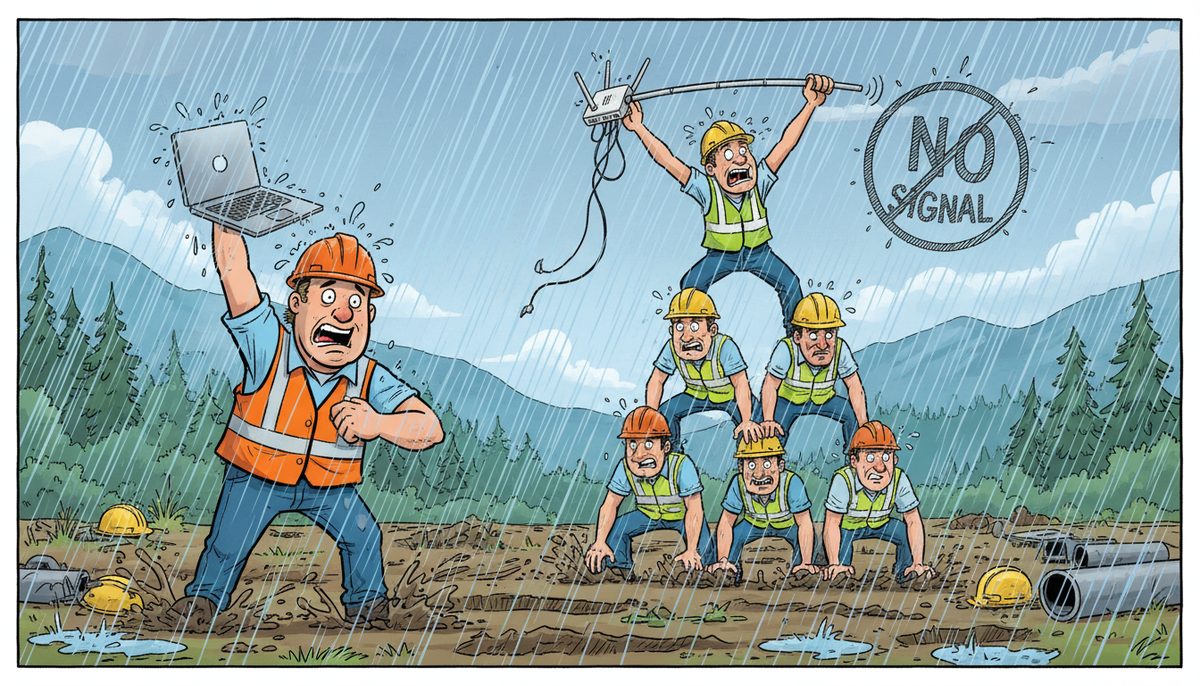
Yes. Construction businesses on Vancouver Island face distinct technology challenges including maintaining connectivity across dispersed job sites from Duncan to remote Cowichan Valley properties, meeting WorkSafeBC documentation requirements, securing data under BC’s Personal Information Protection Act, and managing digital permit submissions to municipal building departments. DataStream Networks has supported Vancouver Island construction companies since 2012 with local technicians who understand these regional demands.
How do you handle IT support when job sites are spread across Vancouver Island?
Construction projects on Vancouver Island often span from municipal builds in Duncan and North Cowichan to remote properties in Lake Cowichan or rural Cowichan Valley locations. Your office staff needs access to project files, but your site supervisors and field teams need real-time connectivity to change orders, RFIs, and as-built drawings.
The challenge intensifies when cellular coverage drops or internet infrastructure doesn’t exist at remote sites. You can’t wait three days for a mainland technician to fly over, and offshore support can’t physically reach a job trailer losing connection mid-pour.
Local Vancouver Island technicians dispatch automatically when remote fixes aren’t possible. They understand which areas have reliable LTE, where satellite solutions make sense, and how to configure mobile hotspots that actually work in the field. Most connectivity issues resolve remotely within minutes because the support team knows the Island’s infrastructure limitations.
A Victoria construction professional, experienced this firsthand: “DataStream installed a new backup system, provided security for our network, and established a roadmap for future projects. DataStream thoroughly cleaned our file sharing, implemented password control, and smoothly transitioned us to take back control of our network.” His systems were running slow before DataStream intervened—now they’re not.
Job site connectivity isn’t just convenience. It’s the difference between a superintendent accessing updated drawings on-site versus driving 40 minutes back to the Duncan office, delaying the concrete truck and costing you thousands in standby time.
What happens when WorkSafeBC requires documentation and your systems go down?
WorkSafeBC mandates specific safety reporting and incident documentation. When an injury occurs on site, you have legal obligations to report within tight timeframes. If your server crashes or ransomware locks your files, you can’t access safety training records, equipment inspection logs, or incident reports.
BC’s construction sector faces regular WorkSafeBC audits. Inspectors expect immediate access to training certifications, hazard assessments, and toolbox talk documentation. Missing or inaccessible records result in penalties and work stoppages.
Construction companies face average downtime costs exceeding $5,600 per hour when systems fail during critical documentation periods.
Automatic data backup runs continuously, not just overnight. If a site supervisor’s laptop fails during a safety incident, their documentation exists in secure, geographically redundant backup systems. Recovery happens in minutes, not days.
The Builders Lien Act compounds this challenge. You must maintain meticulous records of contracts, payments, and change orders. CRA audit requirements demand seven years of financial documentation retention. A single ransomware attack without proper backup can destroy records you’re legally required to preserve.
Daryl Wood, another construction professional, put it plainly: “Considering all the cyber threats facing businesses today, you have to ask, what happens if your systems go down and you can’t operate for several days? If this would cause you big problems, I’d suggest protecting yourself by selecting DataStream as your security partner and get some peace of mind knowing they have it covered.”
Peace of mind comes from knowing your WorkSafeBC documentation, lien records, and CRA-required files survive any disaster.
How do you manage digital permit submissions across multiple municipal systems?
Construction companies working across the Cowichan Valley interact with different building departments: the Cowichan Valley Regional District, Municipality of North Cowichan, and City of Duncan each maintain separate digital permit systems. Add provincial submissions for larger projects, and you’re managing multiple portals with different security requirements.
Each system demands secure credentials, often with two-factor authentication. Your estimators need access to submit bids. Project managers need to track inspection schedules. Administrative staff handle permit renewals. When someone leaves your company, you must immediately revoke their access across all systems.
Password control becomes critical. Weak or shared passwords create liability under BC’s Personal Information Protection Act (PIPA). If unauthorized access occurs because your former employee still had credentials, your company bears responsibility.
Centralized password management with role-based access ensures the right people access the right systems. When a site supervisor leaves, one click revokes all their municipal portal access. When inspection results post, automated notifications reach the relevant project manager immediately.
Email security matters equally. Municipal building departments send permit approvals, inspection notices, and deficiency reports via email. If spam filters are too aggressive, you miss a critical inspection notice. If they’re too weak, phishing emails compromise your credentials to municipal systems.
Mailbox protection blocks sophisticated phishing attempts targeting construction companies while ensuring legitimate municipal communications reach you instantly.
Why does seasonal construction workflow create unique IT demands?
Vancouver Island construction follows weather-dependent cycles. Winter months slow outdoor projects but accelerate indoor renovations and planning for spring builds. Your IT needs fluctuate dramatically.
During peak season, you might have 15 people in the field needing mobile access, five office staff managing coordination, and three estimators preparing bids. In slower months, field staff drops to six, but your office team expands as they process year-end financials and plan next season.
Fixed IT costs don’t match this reality. You don’t need the same support level in January as you do in July. But you can’t sacrifice security or backup during slow periods—that’s when you’re processing T4s, preparing for CRA audits, and updating your systems for the coming season.
Managed IT services scale with your actual headcount. Add users when you hire seasonal field supervisors in April. Remove them in November when projects wind down. Your backup systems, security monitoring, and help desk access remain constant regardless of seasonal staffing.
The alternative—hiring a full-time IT person—costs $65,000–$85,000 annually plus benefits for someone who may not have construction-specific experience. And when they’re on vacation or sick, you have no coverage.
Local support understands Vancouver Island construction cycles because they support multiple companies in the sector. They anticipate your spring ramp-up needs and help you plan technology upgrades during slower winter months when downtime is less disruptive.
How do you protect sensitive bid information and client data?
Construction bids contain your most sensitive competitive information: your cost estimates, subcontractor pricing, profit margins, and project approach. If competitors access your bid files, they undercut your pricing or steal your methodology.
Client data carries equal sensitivity. You hold personal information about property owners, financial details about projects, and confidential architectural plans. PIPA requires you to protect this information with reasonable security safeguards.
A single laptop stolen from a job site or vehicle can expose everything. If that laptop lacks encryption and proper access controls, you’ve violated PIPA. Notification requirements kick in. Your reputation suffers. Clients question whether to trust you with their next project.
Network security prevents unauthorized access even if devices are stolen. Encryption renders data unreadable without proper credentials. Multi-factor authentication ensures that even if someone steals a password, they can’t access your systems without the second verification factor.
Advanced security solutions provide enterprise-grade protection: endpoint detection, network monitoring, encryption, and threat response. These aren’t nice-to-have features—they’re reasonable safeguards under PIPA and practical protection for your competitive advantage.
Cyber awareness training addresses the human element. Your estimators learn to recognize phishing emails disguised as subcontractor quotes. Your project managers understand why they shouldn’t use public Wi-Fi at coffee shops to access bid files. Your administrative staff know how to verify requests for wire transfers before sending deposits to suppliers.
Construction companies are high-value targets because they handle large financial transactions and maintain relationships with multiple subcontractors and suppliers. Criminals impersonate your company to subcontractors or impersonate subcontractors to you, requesting fraudulent payments.
Email spam protection blocks these sophisticated attacks before they reach your inbox, but training ensures your team recognizes threats that slip through.
What makes local Vancouver Island IT support different from mainland or offshore providers?
When your project management software crashes during a pre-construction meeting with the City of Duncan building department, you can’t wait for a callback. When your estimating system fails hours before a bid deadline, “we’ll escalate this” doesn’t help.
Live people answer phones immediately—no voicemail, no phone tree, no long wait times. Most problems resolve remotely within minutes because technicians understand construction workflows and Vancouver Island infrastructure.
When remote resolution isn’t possible, local technicians dispatch automatically. They’re already on the Island, often within 30 minutes of Duncan, Cobble Hill, or Nanaimo. They’ve been to job sites with no cellular service. They know which areas need satellite solutions versus LTE boosters.
Offshore support can’t physically reach your job trailer when the network goes down. Mainland providers schedule ferry trips days in advance, turning a one-hour fix into a three-day problem.
Local presence means understanding regional specifics: how Cowichan Valley Regional District’s digital systems work, which Victoria suppliers use compatible file formats, where connectivity drops between Duncan and Lake Cowichan.
DataStream has been 100% committed to providing the most reliable and professional IT service on Vancouver Island since 2012. That’s 12+ years of understanding Island construction companies’ unique challenges.
The difference shows in response times, problem resolution speed, and the confidence that someone local has your back when technology fails at the worst possible moment.
Key considerations for construction IT on Vancouver Island
- Job site connectivity: Mobile hotspots, LTE boosters, and satellite solutions for remote locations where cellular coverage fails
- Compliance documentation: WorkSafeBC safety records, Builders Lien Act contract documentation, and CRA seven-year retention requirements
- Municipal systems access: Secure credentials for CVRD, North Cowichan, and Duncan building department portals with proper access controls
- Data protection: PIPA-compliant encryption, backup systems, and security safeguards for client and employee information
- Seasonal scalability: IT services that adjust with fluctuating headcount between peak construction season and winter planning periods
- Local response: On-Island technicians who dispatch immediately rather than scheduling ferry trips days in advance
Frequently asked questions
What IT support do construction companies on Vancouver Island typically need?
Construction companies need job site connectivity solutions, secure access to project management and estimating software, WorkSafeBC documentation systems, digital permit submission capabilities, data backup meeting CRA retention requirements, protection under BC’s PIPA, and support that understands seasonal workflow fluctuations. Local technicians who can reach remote sites quickly provide significant advantage over mainland or offshore providers.
How much does managed IT support cost for a construction business?
Managed IT services range from $150–$225 per user/month depending on support level and complexity. Additional security solutions include cybersecurity suite at $25–$50 per device/month, mailbox protection at $5–$15 per user/month, and cyber awareness training at $5–$15 per user/month. Services scale with seasonal staffing changes common in Vancouver Island construction.
What happens if my construction company experiences a ransomware attack?
Ransomware can lock access to project files, financial records, WorkSafeBC documentation, and client data. Without proper backup and security, recovery can take weeks and cost tens of thousands in downtime and ransom payments. Automatic data backup with geographically redundant storage enables recovery within minutes. Advanced security solutions detect and block ransomware before it encrypts files.
Do I need different IT solutions for office staff versus field teams?
Yes. Office staff need reliable network access, secure email, and connections to municipal permit systems. Field teams need mobile connectivity solutions that work across Vancouver Island’s varying infrastructure, secure remote access to project files and drawings, and devices protected against theft or loss. Managed IT providers configure solutions appropriate for each role while maintaining consistent security across all users.
How do I meet BC’s data protection requirements for construction records?
BC’s Personal Information Protection Act requires reasonable safeguards for client and employee data. The Builders Lien Act demands meticulous contract and payment records. CRA requires seven-year retention of financial documentation. Meeting these requirements involves encrypted data storage, secure backup systems, access controls, and documented security policies. Local IT providers understand BC-specific compliance requirements better than offshore or mainland alternatives.