
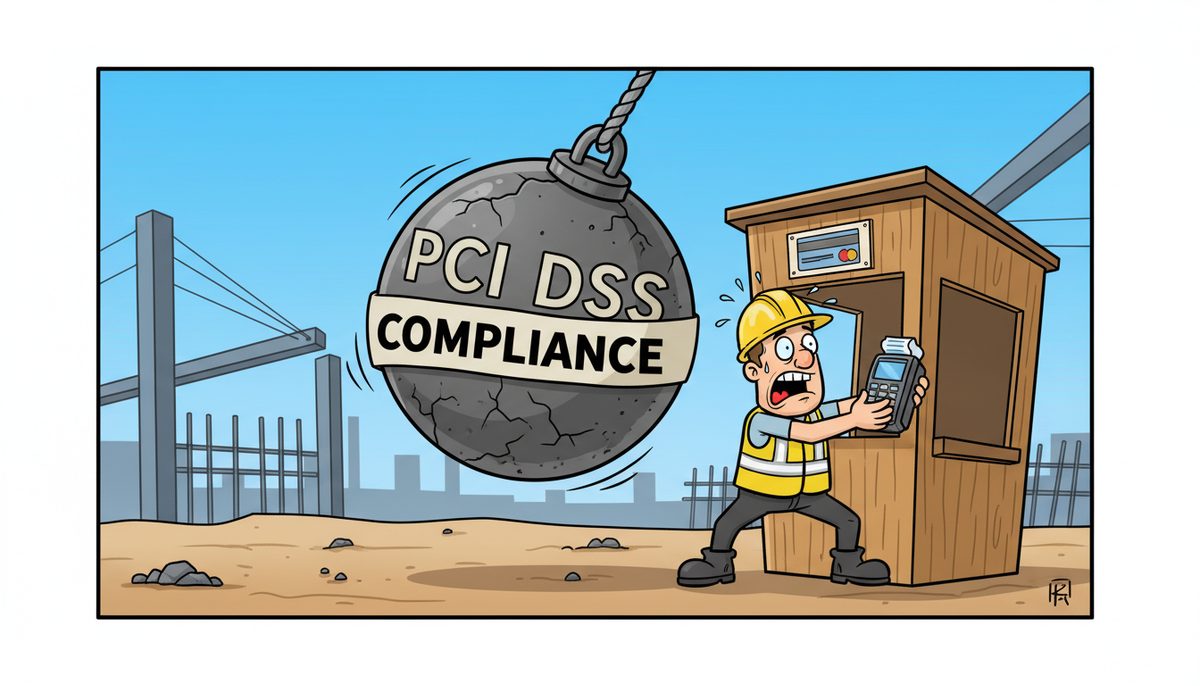
PCI DSS (Payment Card Industry Data Security Standard) is a set of 12 security requirements designed to protect credit card data during processing, storage, and transmission. If your construction business accepts, processes, or stores credit card payments—whether for deposits, progress billing, or final payments—you must comply with PCI DSS standards. Non-compliance can result in fines ranging from $5,000 to $100,000 per month, plus liability for data breaches.
Does My Construction Company Need to Be PCI Compliant?
Your construction business needs PCI DSS compliance if you accept credit cards in any capacity. This includes taking deposits over the phone, processing progress billing payments online, or running cards at your office for materials or services.
The compliance level depends on your transaction volume. Companies processing fewer than 20,000 e-commerce transactions or one million total transactions annually typically fall into Level 4, the simplest tier. Most Vancouver Island construction firms fit this category.
Even if you use a third-party payment processor, you’re not automatically exempt. If your staff handles card numbers at any point—writing them on invoices, entering them into accounting software, or storing them in email—you’re responsible for securing that data.
Many general contractors assume subcontractors handle their own compliance, but if you’re processing payments on behalf of subs or collecting card information for later billing, the responsibility sits with you.
The standard applies regardless of business size. A two-person renovation company accepting cards faces the same core requirements as a large commercial contractor, though the validation process differs by transaction volume.
What Are the Core PCI DSS Requirements for Construction Businesses?
PCI DSS organizes its 12 requirements into six control objectives. Understanding these helps you identify gaps in your current payment processes.
The first objective requires a secure network. You must install and maintain firewall configurations and avoid using vendor-supplied default passwords for systems that touch payment data. This includes your estimating software if it stores client card information.
Protecting cardholder data is the second objective. You cannot store sensitive authentication data after authorization, even if encrypted. This means no keeping CVV codes, magnetic stripe data, or PINs under any circumstances.
The third objective mandates vulnerability management. You must use and regularly update anti-virus software and develop secure systems and applications. For construction companies, this often means ensuring your accounting and project management platforms receive security patches promptly.
Implementing strong access control measures forms the fourth objective. Restrict access to cardholder data on a need-to-know basis, assign unique IDs to each person with computer access, and restrict physical access to payment data.
The fifth objective requires regular network monitoring and testing. Track all access to network resources and cardholder data, and regularly test security systems and processes.
Finally, maintain an information security policy that addresses security for all personnel. This includes background checks for employees who handle payment data and formal security awareness training.
Construction companies processing under 20,000 e-commerce transactions annually can typically self-assess using the SAQ (Self-Assessment Questionnaire) rather than undergoing a full audit.
The Six Core Control Objectives
- Build and maintain a secure network and systems
- Protect cardholder data at all times
- Maintain a vulnerability management program
- Implement strong access control measures
- Regularly monitor and test networks
- Maintain an information security policy
How Do Construction Payment Practices Create PCI Risks?
Construction businesses face unique PCI compliance challenges due to how they handle payments across multiple locations and through various staff members.
Progress billing creates extended data exposure. Unlike retail transactions that complete immediately, construction projects span months. If you’re storing card information to charge against milestones, you’re holding sensitive data far longer than necessary—a significant compliance risk.
Field staff accepting deposits at job sites often lack secure payment infrastructure. A superintendent taking a card number over the phone and texting it to your office violates multiple PCI requirements, yet this practice remains common on Vancouver Island job sites with limited connectivity.
Retention payments complicate compliance further. Some contractors keep card details on file for warranty work or deficiency corrections, creating unnecessary data storage that must be secured according to PCI standards.
Email remains a major vulnerability. Sending invoices with “please call with your card number” instructions seems harmless, but if staff then email those numbers internally or store them in your email system, you’ve created an insecure data environment.
Shared accounting systems pose risks when multiple employees access payment data without proper controls. Your estimator doesn’t need access to stored payment methods, but many construction accounting platforms grant broad permissions by default.
Gayla Andrews, working with construction IT systems, notes: “Luke with DataStream Networks Inc. is always so knowledgeable and helpful. Luke and his team are always happy to help with your IT needs.” This expertise proves critical when construction clients need to identify vulnerabilities in their payment workflows.
The key is recognizing that construction payment workflows—designed for project flexibility—often conflict with PCI security requirements designed for point-of-sale simplicity.
What Steps Should Construction Companies Take to Achieve Compliance?
Achieving PCI compliance requires a systematic approach tailored to how your construction business actually processes payments.
Start by mapping your payment data flow. Document every point where card information enters your business, who handles it, where it’s stored, and how it’s transmitted. Include phone calls, emails, paper invoices, accounting software, and any mobile payment tools.
Eliminate unnecessary data storage immediately. If you’re keeping card numbers “just in case,” stop. Use a payment processor that tokenizes data, giving you a reference number instead of actual card details for future charges.
Segment your network so payment processing happens in an isolated environment. Your estimating workstations and project management systems shouldn’t share network space with payment terminals or systems storing card data.
Implement strong access controls. Create unique login credentials for every employee, restrict payment system access to only those who need it, and log all access attempts. Your field superintendent shouldn’t have the same system permissions as your accounting manager.
Update all systems regularly. Outdated accounting software, unpatched operating systems, and expired antivirus definitions create vulnerabilities that violate PCI requirements. For Vancouver Island construction companies managing multiple job sites, managed IT services can automate these updates across all locations.
Train your entire team on payment security. Everyone from your receptionist to your project managers needs to understand why they can’t email card numbers or write them on work orders. Make this part of your onboarding process.
Complete the appropriate Self-Assessment Questionnaire annually. Most construction firms use SAQ A (if you’ve fully outsourced payment processing) or SAQ D (if you process payments through your own systems). Be honest in your assessment—claiming outsourced processing when staff actually handle card data creates liability.
Consider working with an IT provider who understands both construction workflows and compliance requirements. DataStream Networks offers specialized IT support for construction companies across Vancouver Island, helping firms implement security measures that work with project realities rather than against them.
Document everything. PCI compliance requires written policies, system configurations, and evidence of regular security activities. If you can’t produce documentation during an audit or after a breach, compliance claims won’t hold up.
Essential Compliance Steps
- Map complete payment data flow across all systems and staff
- Eliminate unnecessary card data storage
- Segment networks to isolate payment processing
- Implement unique access credentials and logging
- Maintain current security patches and antivirus
- Train all staff on payment security protocols
- Complete annual Self-Assessment Questionnaire
- Document all policies and security measures
What Are the Consequences of Non-Compliance for Construction Firms?
The financial and operational consequences of PCI non-compliance can devastate a construction business, especially smaller contractors operating on tight margins.
Monthly fines start at $5,000 and can reach $100,000 depending on the violation severity and duration. Your payment processor assesses these penalties, often without warning, and can hold them from your merchant account balance.
Data breach liability extends far beyond fines. If compromised card data leads to fraudulent charges, you’re responsible for reimbursing card issuers, covering forensic investigations, and paying for credit monitoring services for affected customers. A single breach can cost a small construction company $50,000 to $500,000.
Loss of payment processing privileges represents an existential threat. Payment processors can terminate your merchant account for non-compliance, forcing you to operate on a cash-only basis. For construction companies relying on credit card deposits and progress payments, this effectively shuts down new business.
Reputational damage in Victoria’s tight-knit construction community spreads quickly. Word that your company suffered a payment data breach reaches potential clients, subcontractors, and suppliers fast. The island’s construction network is small enough that trust, once lost, rarely returns.
Increased insurance costs follow any security incident. Cyber liability insurance premiums rise substantially after a breach, and some insurers refuse coverage entirely to companies with non-compliance histories.
Legal liability from affected customers adds another layer of risk. Class action lawsuits following data breaches have become common, and construction companies lack the legal resources that larger retailers deploy to defend against them.
For Vancouver Island contractors, these risks compound during busy construction seasons when payment volumes peak and staff attention focuses on project delivery rather than security protocols.
How Can Vancouver Island Construction Companies Maintain Ongoing Compliance?
PCI compliance isn’t a one-time checklist but an ongoing operational requirement that must integrate with your construction business workflows.
Schedule quarterly security reviews rather than waiting for your annual assessment. Technology changes, staff turnover happens, and new payment methods emerge. Regular reviews catch compliance gaps before they become violations.
Monitor your payment systems continuously. Implement logging that tracks who accesses payment data, when, and from where. Review these logs monthly for unusual patterns—an estimator accessing payment records at midnight from home warrants investigation.
Update security training when you hire new staff or change payment processes. Don’t assume employees understand PCI requirements. Make payment security part of your safety culture, alongside WorkSafeBC compliance and job site protocols.
Test your backup and recovery systems regularly. A ransomware attack that encrypts your payment data creates both a security incident and a compliance violation. Knowing you can restore systems quickly limits both operational and compliance damage.
Work with technology partners who understand construction compliance challenges. DataStream Networks provides IT support in Victoria with local technicians who can respond on-site when remote support isn’t sufficient, critical for addressing security incidents before they escalate.
Keep detailed compliance documentation current. When you update a system, change a password policy, or modify network configurations, document it immediately. Retroactive documentation during an audit or investigation never looks credible.
Review your payment processor’s compliance reports. Processors must maintain their own PCI compliance, and their failures can affect you. Verify they provide annual Attestations of Compliance and address any security bulletins they issue.
Plan for the worst. Develop an incident response plan specifically for payment data breaches. Know who you’ll call, what systems you’ll isolate, and how you’ll communicate with affected customers. BC’s privacy laws under FIPPA add reporting requirements for construction companies working on public projects.
Budget for compliance as an operational expense, not an IT project. Factor security updates, training time, and periodic assessments into your overhead just like insurance and licensing fees. Companies processing payments need compliance infrastructure as much as they need project management software.
Ongoing compliance becomes manageable when integrated into normal business operations rather than treated as a separate IT burden. The construction companies that succeed are those that view payment security as part of professional service delivery, not a regulatory obstacle.
Frequently Asked Questions
Do I need PCI compliance if I only accept cards occasionally?
Yes, PCI DSS applies regardless of transaction frequency. Even accepting a single credit card payment annually triggers compliance requirements. The validation method may be simpler for low-volume businesses, but the core security standards remain mandatory. Occasional processing doesn’t reduce your liability if card data is compromised through your systems.
Can I just use Square or PayPal to avoid PCI compliance?
Using third-party processors reduces your compliance scope but doesn’t eliminate it entirely. If you never see, store, or transmit card data—customers enter information directly into the processor’s interface—you qualify for the simplest validation level. However, if staff handle card numbers at any point before entering them into Square or PayPal, full compliance requirements apply.
What’s the difference between PCI compliance levels?
PCI DSS defines four merchant levels based on annual transaction volume. Level 1 processes over six million transactions annually and requires annual on-site audits. Level 4, processing under 20,000 e-commerce or one million total transactions, can self-assess using questionnaires. Most construction companies fall into Level 4, making compliance more accessible but still mandatory.
How much does PCI compliance cost for a small construction company?
Compliance costs vary based on your current security posture and transaction volume. Self-assessment for Level 4 merchants typically costs $500 to $2,000 annually including required network scans. Implementing necessary security controls—firewalls, encryption, access controls—might require initial investments of $2,500 to $10,000 through services like managed IT for construction businesses, depending on your existing infrastructure.
Who validates my PCI compliance?
Validation requirements depend on your merchant level. Level 4 merchants self-assess using the appropriate SAQ and must complete quarterly network vulnerability scans by an Approved Scanning Vendor. Your payment processor typically provides or requires these assessments as part of your merchant agreement. Higher-volume merchants require validation by Qualified Security Assessors.
What happens if I have a data breach?
Data breaches trigger immediate notification requirements to your payment processor, card brands, and potentially affected customers under BC privacy laws. You’ll face forensic investigation costs, potential fines, card reissuance fees, and possible termination of your merchant account. Breaches also expose you to lawsuits from affected parties and dramatically increase future compliance and insurance costs.