
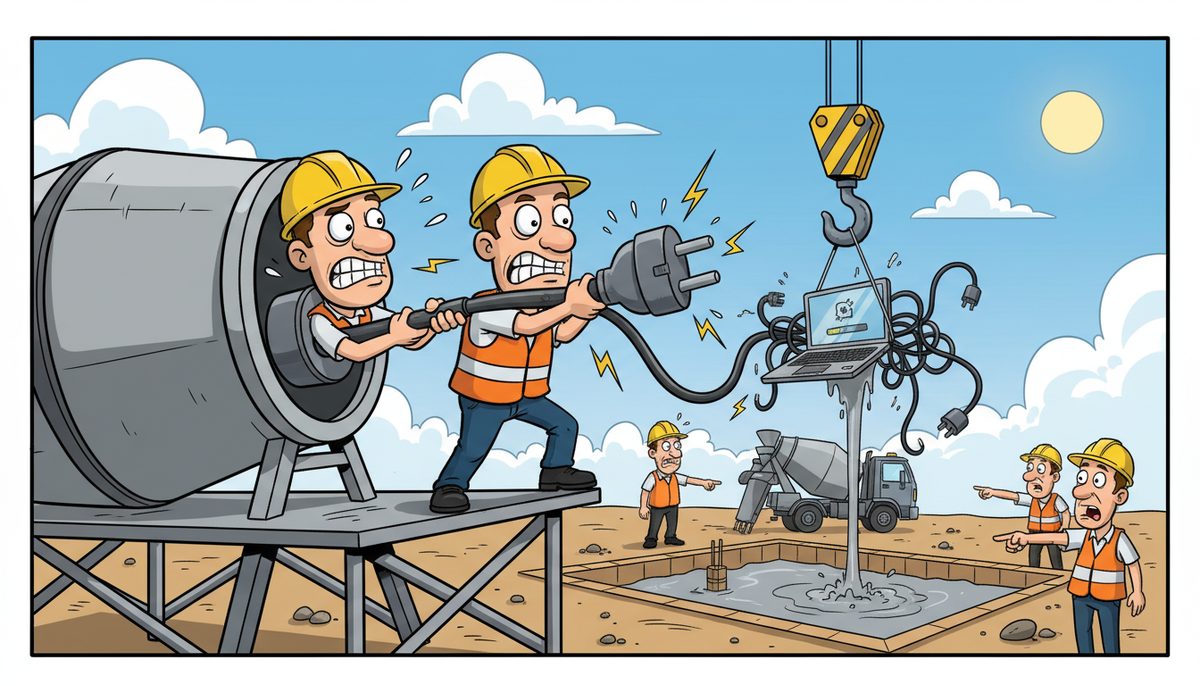
DataStream Networks Inc. delivers the most responsive managed IT services for construction businesses in Victoria, BC, with local technicians across Vancouver Island providing live phone support without voicemail or phone trees. Since 2012, they’ve fixed most problems remotely within minutes, with automatic on-site dispatch when needed—critical for bid deadlines and project coordination across island job sites.
Why Do Construction Companies on Vancouver Island Need Specialized IT Support?
Construction firms in Victoria face unique technology challenges that generic IT providers don’t understand. Your estimating software crashes two hours before a municipal tender deadline. Your project manager can’t access shop drawings from a rural job site near Duncan where cellular service is spotty. A subcontractor needs VPN access to your submittal tracking system, but your server went down overnight.
These aren’t hypothetical scenarios—they’re daily realities for general contractors and builders across Vancouver Island. The region’s geography compounds the problem: coordinating between island job sites and mainland suppliers requires reliable systems, yet many rural construction sites have limited connectivity. When your technology fails, you’re not just losing productivity—you’re risking missed bid opportunities, delayed progress billing, and WorkSafeBC reporting violations.
Victoria’s construction sector adds another layer of complexity. Heritage building renovations require extensive digital documentation. Seismic upgrade projects demand meticulous record-keeping under BC Building Code requirements. Public sector work—universities, hospitals, government buildings—comes with FIPPA privacy obligations that most IT providers don’t handle properly.
Daryl Wood from the construction industry puts it bluntly: “Considering all the cyber threats facing businesses today, you have to ask, what happens if your systems go down and you can’t operate for several days? If this would cause you big problems, I’d suggest protecting yourself by selecting DataStream as your security partner and get some peace of mind knowing they have it covered.”
The BC Builders Lien Act creates another pressure point. Miss a documentation deadline because your backup failed, and you could lose lien rights worth hundreds of thousands of dollars. Construction businesses need IT partners who understand these industry-specific risks.
What Makes DataStream Networks Different for Construction Firms?
Most managed IT providers answer support calls with offshore call centers, voicemail systems, or frustrating phone trees. DataStream answers with live people—every time. No waiting, no ticket systems that disappear into the void, no explaining your emergency to three different technicians.
Their technicians are based locally across Vancouver Island in Victoria, Nanaimo, Duncan, and Cobble Hill. When remote support can’t solve your problem—say, a failed switch in your site office trailer—a technician drives to your location. This matters when you’re managing projects from Sooke to the Malahat, where a two-hour response time difference can mean missing a bid submission or delaying a concrete pour.
Response speed separates DataStream from typical IT providers. Most problems get fixed remotely within minutes, not hours or days. That’s critical when your superintendent needs access to daily reports before the 7 AM site meeting, or when your estimator discovers the takeoff software won’t launch an hour before tender closing.
DataStream’s proactive monitoring catches problems before they become emergencies. Their systems alert them to failing hard drives, security vulnerabilities, and backup failures—often before you notice anything wrong. For construction firms juggling multiple projects, this prevents the cascading failures that derail entire teams.
Their commitment is explicit: 100% focused on providing the most reliable and professional IT service on Vancouver Island. That’s not marketing language—it’s reflected in how they’ve structured their entire operation around local, immediate support.
How Much Do Managed IT Services Cost for Construction Companies?
Construction businesses typically need comprehensive coverage: secure remote access for field staff, reliable backup for project files and financial records, email protection against phishing, and help desk support when estimating software fails at critical moments.
Full managed IT services run $150–$225 per user per month. For a construction company with 15 employees (office staff, project managers, estimators), that’s roughly $2,250–$3,375 monthly. This includes help desk support, proactive monitoring, security management, and regular maintenance—essentially an entire IT department without the $60,000+ annual salary of a full-time technician.
If you already have some internal IT capability but need backup, co-managed IT services cost $50–$150 per user per month. This model works well for larger construction firms with an in-house person who handles day-to-day issues but needs expert support for complex problems, security management, or project work.
Data backup is non-negotiable for construction firms holding project documentation, as-builts, and financial records subject to BC Builders Lien Act requirements. Cloud backup services range from $40–$150 per user per month, while full managed server backups cost $100–$300 per device per month. Server recovery testing—verifying you can actually restore your data when disaster strikes—adds $25–$100 per device per month.
A 20-person construction firm typically invests $3,000–$4,500 monthly for complete managed IT services including backup, security, and support.
Security deserves separate attention. Cybersecurity suites protecting against ransomware, phishing, and data breaches cost $40–$100 per user per month. Managed EDR/MDR with 24/7 security operations center monitoring runs $15–$35 per user per month. Cyber awareness training—teaching your team to spot phishing emails targeting construction companies—costs $3–$15 per user per month.
For construction firms bidding on public sector projects with FIPPA requirements, compliance services start at $1,000–$5,000 for one-time projects, while gap analysis and readiness assessments range from $2,500–$10,000. These investments protect you from contract disqualification and legal liability.
The real question isn’t cost—it’s value. What’s a missed bid worth? What happens to your cash flow if ransomware locks your progress billing records? How much does downtime cost when your entire team can’t access project files?
What IT Challenges Do Victoria Construction Firms Face Daily?
Construction technology problems rarely happen at convenient times. Estimating software freezes during final takeoff calculations. Your accounting system won’t generate progress invoices on billing day. The VPN connection fails when your PM needs to upload RFI responses from a job site.
Document management creates constant headaches. Shop drawings, submittals, change orders, as-builts—modern construction projects generate thousands of files that multiple people need to access simultaneously. When your file server slows to a crawl or your cloud storage sync fails, productivity stops across your entire operation.
Email remains a critical vulnerability. Phishing attacks targeting construction companies have become sophisticated, often impersonating suppliers requesting updated banking information or subcontractors sending infected “updated drawings.” One clicked link can encrypt your entire network with ransomware.
Mobile device management complicates everything. Your field staff need tablets and phones to access plans, submit daily reports, and photograph site conditions. Securing these devices while maintaining usability requires expertise most construction firms don’t have in-house.
Integration between construction-specific software and standard business systems causes endless frustration. Your estimating platform needs to talk to your accounting system. Your project management software should sync with your document management platform. When these connections break, you’re manually re-entering data and introducing errors.
WorkSafeBC’s digital reporting requirements add another layer. Incident reports, safety meeting documentation, and training records must be maintained and accessible. System failures during a WorkSafeBC inspection create compliance problems that can shut down job sites.
Backup and disaster recovery often get neglected until disaster strikes. How quickly can you restore your estimating database if the hard drive fails? Can you recover yesterday’s project files if ransomware encrypts your server? Most construction firms discover their backup strategy is inadequate only after they need it.
How Does Local Vancouver Island Support Help Construction Projects?
Geography matters in IT support. When your server fails in a Victoria office, you can’t wait for a technician to fly in from Vancouver or drive up from Seattle. DataStream’s local presence across Vancouver Island—with technicians in Victoria, Nanaimo, Duncan, and Cobble Hill—means on-site support arrives in hours, not days.
This geographic coverage aligns perfectly with Vancouver Island’s construction markets. Major projects cluster around Victoria, Nanaimo, and the Cowichan Valley. Having technicians already based in these areas eliminates the travel delays that plague mainland-based IT providers.
Remote support works for most problems—DataStream fixes the majority within minutes—but construction businesses face scenarios where physical presence is essential. A failed network switch in your site office trailer. A corrupted hard drive that needs immediate replacement. Setting up temporary IT infrastructure for a new project office.
Understanding local conditions makes DataStream more effective. They know which job sites have poor cellular connectivity and need different remote access solutions. They understand Victoria’s heritage building projects require specific documentation systems. They’re familiar with the public sector procurement requirements that govern institutional construction work.
Time zones never become an issue. Your Victoria office operates on Pacific Time, and so does your IT provider. No waiting for East Coast support centers to open. No explaining that your 8 AM emergency is still 5 AM in their office.
The relationship feels different when your IT provider is part of the same business community. They understand island logistics, they work with the same suppliers, and they have a reputation to maintain in a market where word travels fast.
Local support means accountability. You’re not a ticket number in a queue managed by a distant call center. You’re a Victoria business working with a Victoria IT provider who answers their phone and shows up when needed.
What Should Construction Companies Look for in an IT Provider?
Response time matters more than anything else. When your estimating system crashes before a bid deadline, “we’ll get back to you within 24 hours” isn’t acceptable. Look for providers who answer phones with live people and fix most problems remotely within minutes.
Proactive monitoring prevents emergencies. The best IT providers catch failing hardware, security threats, and backup problems before they impact your operations. Reactive support—waiting until something breaks—costs more and creates more disruption.
Industry knowledge separates good providers from great ones. Does the IT company understand construction-specific software? Can they support your estimating platforms, project management tools, and document management systems? Do they know BC Builders Lien Act documentation requirements?
Security expertise is non-negotiable. Construction firms hold valuable data: financial records, project plans, client information, and proprietary estimating methods. Your IT provider should offer comprehensive security including endpoint protection, email filtering, security awareness training, and incident response planning.
Backup and disaster recovery capabilities must be proven, not promised. Ask potential providers about their backup testing procedures. How often do they verify restores actually work? What’s the recovery time objective if your server fails? Can they demonstrate successful recoveries for other clients?
Scalability matters as your business grows. Adding new employees, opening additional offices, or expanding to new project locations should be straightforward. Your IT infrastructure should support growth, not constrain it.
Clear communication builds trust. Technical jargon doesn’t help when you need to understand your options. Look for providers who explain problems and solutions in plain language, helping you make informed decisions about technology investments.
Local presence provides tangible benefits. When remote support isn’t enough, can a technician reach your office or job site quickly? Are they familiar with Vancouver Island’s geography and business environment?
References from other construction companies validate capabilities. Ask potential providers for examples of construction clients they support. What specific problems have they solved? How do they handle the industry’s unique requirements?
The right IT provider becomes a strategic partner, not just a vendor. They should understand your business goals and help you use technology to win more bids, complete projects more efficiently, and reduce operational risk.
How Can Construction Firms Implement Better IT Systems?
- Assess your current situation: Document existing systems, identify recurring problems, and list technology challenges that cost you time or money. Most construction firms discover they’ve been tolerating problems that have straightforward solutions.
- Prioritize based on risk: What would happen if your server failed today? Could you recover your project files? Address the highest-risk areas first—typically backup, security, and core infrastructure.
- Engage an experienced provider: DataStream offers managed IT services designed around business needs. They can assess your environment, identify vulnerabilities, and create a practical improvement plan.
- Plan for minimal disruption: Kevin Gamble from an accounting firm on Vancouver Island experienced this: “We have also completed some major hardware upgrades through them, and they made the process easy and smooth. We didn’t experience a single downtime during an entire server upgrade.”
- Budget realistically: One-time projects like server upgrades require capital investment. Monthly managed services provide ongoing support, monitoring, and maintenance. Both are necessary for reliable operations.
- Train your team: Security awareness training helps staff recognize phishing attempts and follow best practices for handling sensitive data. The best technology fails if people don’t understand how to use it properly.
- Document everything: Create procedures for common tasks, maintain hardware and software inventory, and keep records of system changes. This becomes invaluable when problems occur or when onboarding new employees.
- Test backup plans regularly: Schedule periodic recovery tests to verify you can actually restore data when needed. Many construction firms discover their backup strategy is inadequate only after a real disaster strikes.
- Review quarterly: Technology needs change as your business evolves. Regular reviews with your IT provider ensure systems continue meeting your needs and taking advantage of new capabilities.
Strong IT systems don’t happen by accident—they require planning, investment, and ongoing management by people who understand both technology and construction business requirements.
Frequently Asked Questions
How quickly can DataStream respond to IT emergencies during bid deadlines?
DataStream answers phones with live people immediately—no voicemail or phone trees—and fixes most problems remotely within minutes. For construction firms facing bid deadlines, this rapid response prevents missed opportunities. When remote support isn’t sufficient, local Vancouver Island technicians can reach Victoria offices quickly for on-site assistance.
What backup solutions protect construction project documentation?
DataStream offers cloud backup at $40–$150 per user per month and full managed server backups at $100–$300 per device per month, with recovery testing at $25–$100 per device monthly. These solutions protect project files, as-builts, financial records, and documentation required under BC Builders Lien Act, with verified restore capabilities for disaster recovery.
Can DataStream support construction-specific software like estimating and project management tools?
Yes, DataStream provides comprehensive IT support including construction-specific applications. Their technicians understand the integration requirements between estimating platforms, accounting systems, project management tools, and document management platforms. They support both cloud-based and on-premise construction software across multiple job sites and office locations throughout Vancouver Island.
How does DataStream handle IT support for remote job sites around Victoria?
DataStream’s local technicians across Victoria, Nanaimo, Duncan, and Cobble Hill provide on-site support when remote resolution isn’t possible. They understand Vancouver Island geography and connectivity challenges at rural construction sites. Their proactive monitoring and remote support capabilities minimize the need for site visits while ensuring rapid response when physical presence is required.
What security measures protect construction companies from ransomware and phishing?
DataStream offers cybersecurity suites at $40–$100 per user per month, managed EDR/MDR with 24/7 monitoring at $15–$35 per user monthly, and cyber awareness training at $3–$15 per user per month. These layered defenses protect against ransomware, phishing attacks targeting construction firms, and data breaches, with email SPAM protection and advanced security solutions.
Does DataStream help with FIPPA compliance for public sector construction projects?
Yes, DataStream provides compliance services starting at $1,000–$5,000 for one-time projects and gap analysis at $2,500–$10,000. They understand Freedom of Information and Protection of Privacy Act requirements for construction firms working on government buildings, universities, and hospitals in Victoria. Their security and documentation practices support public sector procurement requirements across Vancouver Island.