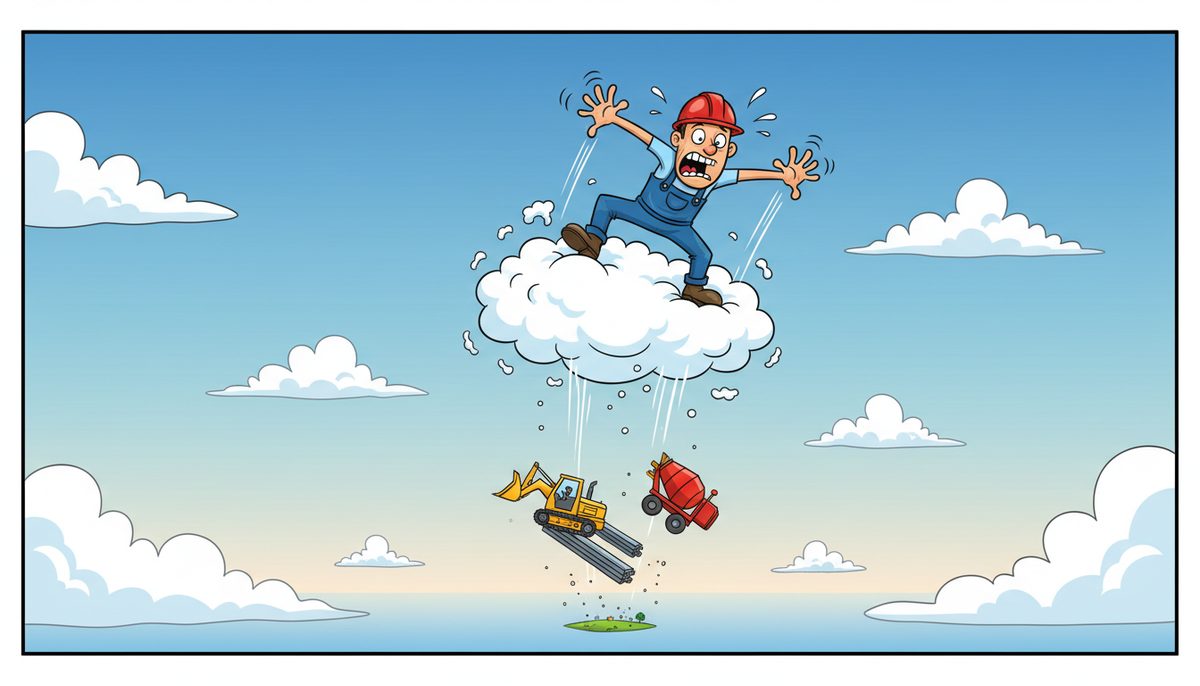
Infrastructure as a Service introduces unpredictable monthly costs that escalate 30-50% beyond initial estimates, exposes your construction company to internet-dependent downtime during critical bid deadlines, and creates control gaps where you’re dependent on distant providers who don’t understand WorkSafeBC reporting timelines or Builders Lien Act documentation requirements. For Vancouver Island contractors coordinating between island job sites and mainland suppliers, these disadvantages directly threaten your ability to submit tenders on time.
Why Does IaaS Create Cost Overruns That Blindside Your Construction Company?
IaaS pricing models charge by usage—compute hours, storage capacity, data transfer, and API calls. What starts as an attractive base rate quickly compounds when your estimating team runs complex takeoffs simultaneously, when field staff upload photos and daily reports from multiple job sites, or when you transfer large BIM files to architects and engineers.
Your construction company faces unpredictable workload spikes. During tender season, your team might run estimating software around the clock for two weeks, then barely touch it for a month. IaaS providers bill for peak capacity, not average usage. You pay premium rates for the computing power needed during your busiest periods, even though those periods represent a fraction of your annual workload.
Data egress fees—charges for moving data out of the cloud—catch you off guard. Every time you download project files, export as-builts to send to clients, or pull historical bid data for analysis, you’re billed. A single large project archive retrieval can cost hundreds of dollars you never budgeted.
Construction companies report IaaS bills climbing 40-60% within the first year as usage patterns become clear and hidden fees accumulate.
Currency fluctuations add another layer of uncertainty for your Canadian operation. Most major IaaS providers bill in US dollars. When the exchange rate shifts, your monthly infrastructure cost changes without any change in your actual usage. This makes financial planning difficult when you’re managing retention holdbacks and progress billing cycles.
IaaS creates a cost structure that’s fundamentally misaligned with how your construction company operates—you need predictable overhead to price bids accurately, not variable infrastructure costs that fluctuate based on project intensity.
How Does Internet Dependency Put Your Tender Deadlines at Risk?
IaaS requires constant internet connectivity. Your estimating software, project files, and bid documents live in someone else’s data center. When your internet connection fails, you’re locked out completely. There’s no local fallback, no cached files, no way to keep working while the connection is restored.
Your Vancouver Island job sites face unique connectivity challenges. Sites in rural areas near Duncan, Cobble Hill, or up-island locations often have limited cellular coverage. When your superintendent needs to access shop drawings or submit an RFI from the field, IaaS infrastructure becomes inaccessible. Your project doesn’t stop because the internet is spotty—but your access to critical documentation does.
Internet service provider outages on the island can last hours. When Shaw or Telus experiences a regional disruption, you’re completely dependent on their repair timeline. If that outage happens the morning a tender is due, you can’t access your estimating files, can’t finalize your bid, and can’t submit on time. The IaaS provider’s infrastructure is running perfectly—but you might as well not have it.
Latency issues slow down your work even when connections are stable. Opening large BIM files or rendering complex drawings over the internet takes longer than accessing them from a local server. Those extra seconds per file add up to hours over a bid cycle, putting time pressure on your estimators when they’re already racing a deadline.
For your construction company where a single missed tender can eliminate six months of potential revenue, internet dependency isn’t just an inconvenience—it’s an existential risk to your pipeline.
What Control Do You Lose When Your Infrastructure Lives Somewhere Else?
IaaS means your servers, storage, and network equipment physically exist in a provider’s data center, often in a different province or country. You configure and manage the virtual environment, but you have zero control over the underlying hardware, facility security, or physical access.
When something breaks at the infrastructure layer—a storage array fails, a network switch malfunctions, or power systems have issues—you’re entirely dependent on the provider’s technicians and their priorities. Your urgent need to access submittals before a construction meeting doesn’t automatically become their emergency. You’re one ticket in a queue with thousands of other customers.
Data sovereignty becomes murky. BC’s Freedom of Information and Protection of Privacy Act (FIPPA) governs many public construction projects in Victoria. When your project data lives on servers in the United States or Europe, you’re navigating complex questions about jurisdiction, lawful access by foreign governments, and compliance with provincial privacy requirements. Some public sector clients explicitly prohibit storing their project information outside Canada.
You can’t walk into the data center when you need immediate answers. If you suspect a security breach, need to verify backup integrity before a critical recovery, or want to physically inspect where your bid documents are stored, you’re locked out. The provider might offer remote monitoring tools and reports, but you’re trusting their word about what’s actually happening with your infrastructure.
Vendor lock-in restricts your future options. IaaS providers use proprietary management tools, APIs, and configurations. After you’ve built your environment in one provider’s ecosystem, migrating to another provider or back to on-premises infrastructure requires significant re-engineering. You’re functionally trapped unless you’re willing to invest heavily in migration.
Your construction company needs control during disputes and legal proceedings. When you’re facing a Builders Lien Act claim and need to produce specific project documentation with chain-of-custody verification, having your data controlled by a distant third party complicates the process and introduces delays you can’t afford.
Why Do Security and Compliance Become More Complex with IaaS?
IaaS operates on a shared responsibility model. The provider secures the physical infrastructure and hypervisor layer. You’re responsible for securing everything above that—operating systems, applications, data, network configuration, and access controls. This division of responsibility creates gaps where security issues fall through the cracks.
Your construction company rarely has dedicated security staff. You’re managing projects, coordinating subs, and chasing change orders—not monitoring firewall rules and patching virtual machines. IaaS assumes you have the expertise to properly configure security groups, implement encryption, manage identity access, and monitor for threats. Most contractors don’t, which leaves vulnerabilities unaddressed.
WorkSafeBC incident reporting requires specific data handling procedures. When your safety documentation and incident records live in IaaS infrastructure, you need to verify the provider’s data handling meets regulatory requirements. If an incident occurs and WorkSafeBC requests records, you’re dependent on the provider’s ability to produce logs and documentation within mandated timeframes.
Ransomware attacks target construction companies specifically because of tight deadlines and high-value bid information. When your infrastructure is in the cloud, you’re trusting the IaaS provider’s backup and recovery capabilities. But their backup might not meet your recovery time objectives—if you need to restore estimating files within an hour to meet a tender deadline, and the provider’s recovery process takes four hours, you’ve still lost the bid.
Multi-tenant environments mean you’re sharing physical hardware with other customers. While virtualization provides isolation, vulnerabilities in the hypervisor or side-channel attacks can potentially expose your data to other tenants. For your construction company handling confidential bid information or proprietary estimating methods, this shared infrastructure model introduces risks that don’t exist with dedicated on-premises equipment.
Compliance audits become more complicated. When auditors need to verify your data handling practices for insurance, bonding, or client requirements, you’re producing documentation about infrastructure you don’t directly control. The IaaS provider’s compliance certifications might not align with your specific industry requirements, creating gaps you have to explain and mitigate.
How Does Distance From Support Create Problems During Your Construction Emergencies?
IaaS providers offer support, but it’s generalized technical support for their platform—not support that understands construction workflows, tender deadlines, or the specific software you run. When your estimating application crashes hours before a bid is due, the IaaS support team can tell you the virtual machine is running and network connectivity is fine, but they can’t troubleshoot why your estimating software won’t open your takeoff files.
Support tickets move through tiered systems. You start with Level 1 support reading from scripts, escalate to Level 2 if they can’t resolve it, and might eventually reach Level 3 engineers who actually understand the infrastructure. This escalation process takes hours or days—time you don’t have when the architect needs updated submittals this afternoon or the general contractor is waiting for your change order pricing.
Time zones create response delays. Many IaaS providers operate support centers in different time zones. When your server becomes inaccessible at 4 PM Pacific time and you need it fixed before tomorrow’s construction meeting, you’re hoping the overnight support shift in another region prioritizes your ticket and has the expertise to resolve it remotely.
Ron Jasper, who provides ERP and point-of-sale software to businesses, noted his experience with clients using various infrastructure providers: “I’ve worked with clients using Datastream’s infrastructure and security services. I have always been impressed with their deep appreciation of both the technical and business considerations when providing servers, networks, security, firewalls, vpns and other IT provisions.” His clients thanked him for the recommendation specifically because the support understood their business context, not just the technical infrastructure.
IaaS support can’t dispatch someone to your office or job site. When remote troubleshooting fails and you need hands-on help, the IaaS provider has no local presence. You’re left finding a third-party technician who can work with the cloud infrastructure, adding another layer of coordination and delay when you’re already under deadline pressure.
For your Vancouver Island construction company, the ferry creates an additional barrier. Mainland IT providers supporting IaaS implementations need to schedule ferry crossings to reach your location. A problem that emerges Tuesday afternoon might not get on-site attention until Thursday, after the tender deadline has passed and the opportunity is lost.
When Does Local Infrastructure Make More Sense Than IaaS for Your Construction Company?
Your construction company needs infrastructure that aligns with how you actually work—predictable costs for accurate bid pricing, local access during internet outages, and support that understands tender deadlines matter more than generic SLAs.
We know what it feels like when your estimating software crashes at 4 PM and the tender closes at noon tomorrow—watching the clock tick while wondering if help will arrive in time. We understand the panic when you can’t access submittals or RFIs that the architect needs today, and you’re stuck in a support queue with no idea when someone will actually fix the problem.
Since 2012, DataStream Networks has served Vancouver Island construction companies with local technicians in Victoria, Nanaimo, Duncan, and Cobble Hill. When you call, you talk to a real person immediately—no voicemail, no phone trees, no overseas call centers. Most problems get fixed remotely within minutes. When remote resolution isn’t possible, a technician is automatically dispatched to your office or job site anywhere on the island.
Here’s how your construction company eliminates infrastructure risks:
- Call and talk to a real local technician immediately who understands construction deadlines—no voicemail or phone trees.
- Get your estimating software, project files, or network diagnosed and fixed remotely within minutes in most cases.
- If needed, a technician is automatically dispatched to your office or job site anywhere on Vancouver Island—no waiting for ferry schedules or hoping a distant provider prioritizes your ticket.
Success looks like submitting every bid on time with confidence, knowing your estimating software and project files are protected and accessible even during critical deadlines. Your field staff access drawings and daily reports reliably from job sites across the island. Your bid documents, submittals, shop drawings, and as-builts are backed up and recoverable if disaster strikes. You keep projects on schedule because technology works when you need it, supported by people who understand that construction deadlines aren’t negotiable.
If you’re evaluating infrastructure options and wondering whether IaaS fits how your construction company actually operates, call (250) 929-0745 to talk to a real technician now about what makes sense for your specific situation.
You can also learn more about how managed IT services designed for business operations differ from generic cloud infrastructure, or explore technology solutions built specifically for construction companies on Vancouver Island.
Frequently Asked Questions
Can IaaS handle construction-specific software like estimating and project management tools?
IaaS can technically run construction software, but performance depends entirely on internet connectivity and proper configuration. Estimating applications with large material databases and BIM integration often perform poorly over internet connections compared to local servers. You’re also responsible for all software licensing, updates, and troubleshooting—the IaaS provider only maintains the underlying infrastructure, not your construction applications.
What happens to my project files if the IaaS provider goes out of business?
You’re dependent on the provider’s data export capabilities and your ability to quickly migrate to new infrastructure. Most contracts include data retrieval provisions, but executing them during a provider shutdown is chaotic. Your construction company with active projects can’t afford weeks of downtime during migration. Local backups independent of the IaaS provider are essential insurance, but many contractors don’t maintain them.
Is IaaS cheaper than maintaining my own server for a small construction company?
Initial costs appear lower because you avoid upfront hardware purchases, but monthly fees accumulate indefinitely and typically exceed local server costs within 2-3 years. Small construction companies with 5-15 users often find local IT support with on-premises equipment costs less over time and eliminates internet dependency during critical bid periods when reliability matters most.
Can I use IaaS for some systems and keep others local?
Hybrid approaches are possible but add complexity. You’re managing two separate infrastructure environments, synchronizing data between them, and coordinating security across both. Your construction company rarely has IT staff to manage this complexity effectively. The hybrid model often creates more problems than it solves unless you have clear technical expertise and specific reasons certain systems must be cloud-based.
How do I ensure my IaaS provider meets BC privacy requirements for public construction projects?
Verify the provider stores data exclusively in Canadian data centers and provides contractual guarantees about data sovereignty and lawful access provisions. Request documentation of their compliance with FIPPA requirements. Many construction companies discover too late their IaaS provider’s standard terms don’t meet public sector privacy requirements, forcing expensive migrations or disqualifying them from institutional projects.