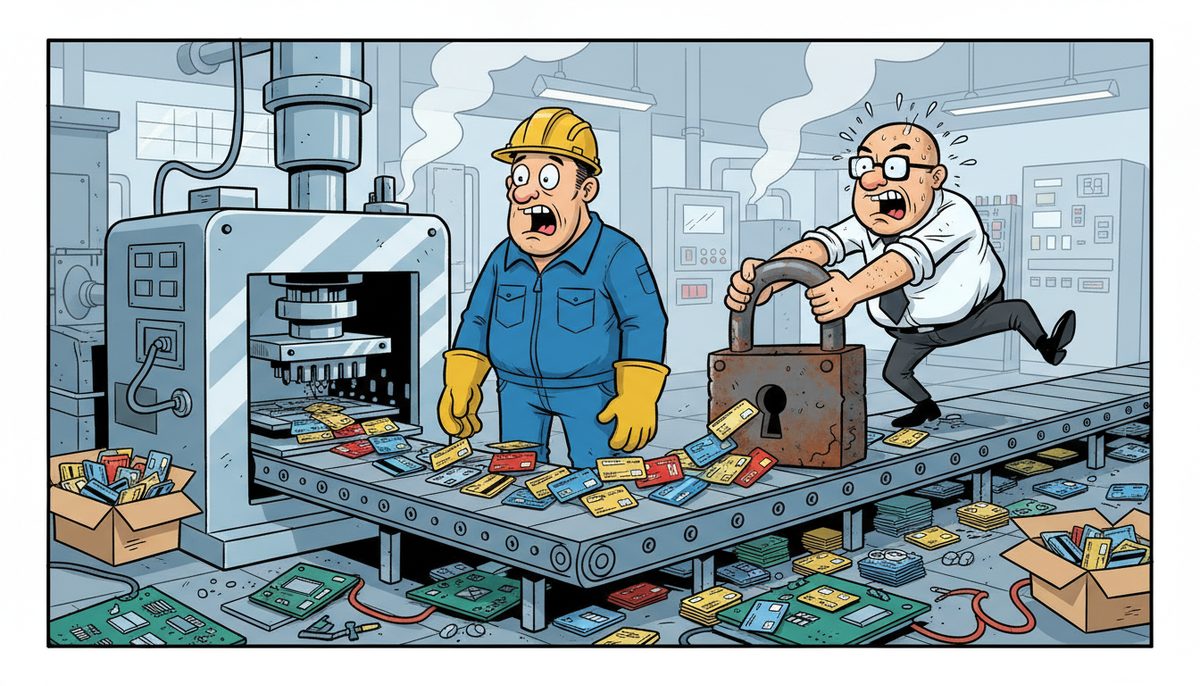
PCI DSS (Payment Card Industry Data Security Standard) is a set of 12 security requirements designed to protect credit card data during processing, storage, and transmission. If your manufacturing business accepts, processes, stores, or transmits credit card information—whether from direct consumer sales, trade show transactions, or customer payments—you must comply. Non-compliance results in fines ranging from $5,000 to $100,000 per month plus liability for breaches.
Does my manufacturing operation need PCI DSS compliance?
Your manufacturing business needs PCI DSS compliance if you handle credit card payments in any capacity. This includes processing customer orders over the phone, accepting cards at your facility’s front desk, running e-commerce sales of manufactured products, or taking payments at trade shows and industry events.
The requirement applies regardless of transaction volume. A boat builder in Victoria taking occasional direct customer deposits faces the same compliance obligation as a food processing facility in Nanaimo running a consumer-facing retail operation, though the validation level differs based on annual transaction volume.
Many Vancouver Island manufacturers assume PCI DSS only applies to retail businesses, but any company that touches cardholder data falls under the standard. If you use a payment processor or merchant services provider, your contract likely requires PCI compliance as a condition of service.
The standard covers four merchant levels based on annual Visa transaction volume:
- Level 1: Over 6 million transactions annually
- Level 2: 1 to 6 million transactions annually
- Level 3: 20,000 to 1 million e-commerce transactions annually
- Level 4: Fewer than 20,000 e-commerce transactions or up to 1 million total transactions annually
Most manufacturing businesses fall into Level 4, which has simpler validation requirements but identical security obligations.
If you outsource all payment processing to a third-party provider and never see, store, or transmit card data yourself, your compliance burden reduces significantly—but you still need to validate that your systems don’t inadvertently capture or store cardholder information.
What are the 12 PCI DSS requirements for manufacturers?
The PCI DSS framework organizes security controls into six objectives with 12 specific requirements. Understanding these helps manufacturers identify gaps in their current systems and prioritize remediation efforts.
Build and Maintain a Secure Network: Requirement 1 mandates firewall configuration to protect cardholder data. Requirement 2 prohibits using vendor-supplied defaults for system passwords and security parameters. For manufacturers, this means securing not just office networks but any industrial systems connected to payment processing.
Protect Cardholder Data: Requirement 3 requires protecting stored cardholder data through encryption or tokenization. Requirement 4 mandates encrypting card data during transmission across public networks. Many manufacturers fail here by storing card numbers in order management systems or email without proper encryption.
Maintain a Vulnerability Management Program: Requirement 5 requires anti-virus software on all systems that handle card data. Requirement 6 mandates developing and maintaining secure systems and applications, including regular security patches. Production downtime concerns sometimes delay critical security updates, creating compliance gaps.
Implement Strong Access Control Measures: Requirement 7 restricts access to cardholder data to only those with a business need. Requirement 8 requires unique IDs for anyone with computer access. Requirement 9 restricts physical access to cardholder data. Shop floor environments often struggle with physical security when payment terminals sit near production areas.
Regularly Monitor and Test Networks: Requirement 10 requires tracking and monitoring all access to network resources and cardholder data. Requirement 11 mandates regular security system and process testing. These ongoing requirements demand consistent attention, not one-time fixes.
Maintain an Information Security Policy: Requirement 12 requires a comprehensive security policy that addresses information security for employees and contractors. This includes security awareness training and incident response procedures tailored to your manufacturing environment.
Most Vancouver Island manufacturers can achieve compliance without disrupting production operations when they work with IT providers who understand both industrial systems and payment security requirements.
How do I validate PCI DSS compliance for my manufacturing business?
Validation requirements depend on your merchant level and how you process payments. Level 4 merchants—the category covering most manufacturers—typically complete an annual Self-Assessment Questionnaire (SAQ) and quarterly network vulnerability scans by an Approved Scanning Vendor.
The SAQ comes in different versions based on your payment processing method:
- SAQ A: Applies when you outsource all payment processing with no electronic storage
- SAQ A-EP: Covers e-commerce with outsourced processing
- SAQ D: Most comprehensive, required when you process or store card data on your own systems
Completing an SAQ honestly requires understanding your payment data flow. Where does card data enter your environment? Which systems touch it? How is it transmitted, processed, and stored? Many manufacturers discover unexpected data storage—in backup systems, email archives, or order management databases—during this assessment.
Quarterly vulnerability scans must be performed by an Approved Scanning Vendor (ASV) who checks your external-facing systems for security weaknesses. These scans identify configuration problems, missing patches, and vulnerable services that attackers could exploit to access cardholder data.
DataStream Networks provides managed IT services that include security monitoring and vulnerability management, helping Vancouver Island manufacturers maintain continuous compliance rather than scrambling before annual validation deadlines.
Your payment processor or acquiring bank will specify exactly which validation documents you must submit and how often. Missing validation deadlines results in non-compliance fees added to your monthly merchant account charges.
What happens if my manufacturing business isn’t PCI compliant?
Non-compliance creates both immediate financial penalties and long-term liability risks. Payment card brands impose monthly fines starting at $5,000 and escalating to $100,000 depending on violation severity and duration. Your acquiring bank typically passes these fines directly to your business.
More significantly, non-compliant businesses bear full liability for data breaches. If attackers steal customer card data from your systems, you’re responsible for breach notification costs, forensic investigation fees, card reissuance expenses, and fraud losses. These costs easily reach hundreds of thousands of dollars even for small breaches.
Richard, a business owner who experienced a server crash on New Year’s Eve, discovered how quickly system problems escalate. DataStream technician Miguel arrived before noon, not only fixing the immediate problem but implementing an enhanced backup system that made the entire operation smoother and more streamlined. The same-day written report documented the improvements, and follow-up support came with explanations in non-technical language the entire office staff could understand.
Beyond financial penalties, breaches damage customer trust and business reputation. Vancouver Island’s tight-knit manufacturing community means word travels fast. A payment security incident can cost you customer relationships and referral business that took years to build.
Some manufacturers lose their ability to accept credit cards entirely following serious compliance violations or breaches. This forces you into cash-only or alternative payment arrangements that create friction with customers and limit business growth.
WorkSafeBC regulations for technology in industrial environments add another layer of consideration for island manufacturers. Security measures must protect both data and worker safety, particularly when payment terminals or connected devices operate near production equipment.
The Office of the Privacy Commissioner of Canada and BC’s Office of the Information and Privacy Commissioner also have jurisdiction over how you handle customer payment information under PIPEDA and BC PIPA. Non-compliance with PCI DSS often indicates violations of these broader privacy regulations as well.
How much does PCI DSS compliance cost for a manufacturing business?
Compliance costs vary based on your current security posture, payment processing methods, and transaction volume. Initial gap analysis and readiness assessment typically range from $2,500 to $10,000, identifying exactly what you need to fix before validation.
Most Level 4 manufacturers spend between $5,000 and $15,000 in the first year achieving compliance, then $2,000 to $5,000 annually maintaining it.
Here’s a breakdown of typical compliance expenses:
| Compliance Component | Typical Cost Range | Frequency |
|---|---|---|
| Gap analysis and readiness assessment | $2,500 – $10,000 | One-time |
| Policy and documentation development | $1,500 – $7,500 | One-time |
| Basic endpoint protection | $5 – $12 per device | Monthly |
| Comprehensive cybersecurity suite | $40 – $100 per user | Monthly |
| Managed EDR/MDR with 24×7 SOC | $15 – $35 per user | Monthly |
| Quarterly vulnerability scanning (ASV) | $150 – $400 | Quarterly |
| Full managed IT services | $150 – $225 per user | Monthly |
Full managed IT services at $150 to $225 per user monthly often prove more cost-effective than piecemeal compliance efforts. This includes ongoing security monitoring, patch management, backup verification, and compliance support—everything needed to maintain PCI DSS requirements while also supporting your manufacturing operations.
For manufacturers serving US markets from Vancouver Island, cross-border data handling adds complexity but not necessarily significant cost if your IT infrastructure already meets Canadian privacy requirements under PIPEDA and BC PIPA.
The alternative—non-compliance—costs far more. Monthly non-compliance fees plus breach liability exposure dwarf the investment in proper security controls. DataStream’s managed IT services for Victoria manufacturers include security solutions designed to meet compliance requirements without disrupting production schedules.
Can I achieve PCI compliance without disrupting manufacturing operations?
Yes, when you approach compliance strategically and work with IT providers who understand manufacturing environments. The key is implementing security controls that protect payment data without interfering with production systems, shop floor operations, or critical manufacturing applications.
Network segmentation isolates payment processing systems from industrial control systems, SCADA networks, and production line equipment. This reduces your compliance scope—fewer systems need PCI controls—while protecting operational technology from payment security measures that might cause conflicts.
Many Vancouver Island manufacturers successfully run payment terminals on separate network segments from their ERP systems, CAD/CAM workstations, and CNC machine connections. This architecture lets you apply strict payment security controls without touching production-critical systems that can’t tolerate security software or frequent reboots.
Scheduling security updates and vulnerability scans during planned maintenance windows or off-shift hours prevents production disruptions. DataStream’s local Vancouver Island technicians understand the cost of manufacturing downtime and coordinate security work around your production schedule, not generic maintenance windows.
Remote monitoring and management tools let IT providers maintain security controls without constant on-site visits that distract your team. Most security tasks—log review, vulnerability scanning, patch deployment—happen remotely. When on-site work is necessary, automatic dispatch sends technicians to your Victoria, Duncan, or Nanaimo facility without ferry delays or mainland travel time.
Employee training integrates into existing safety and operational training rather than creating separate compliance burdens. Shop floor workers need simple, clear guidance: never write down card numbers, don’t email payment information, report suspicious payment terminal behavior immediately.
The island’s geography makes local IT support especially valuable for compliance. Longer wait times for equipment and parts mean you can’t afford extended downtime from security incidents or botched compliance implementations. Working with providers who understand both PCI requirements and manufacturing operations prevents costly mistakes.
Frequently asked questions
Do I need PCI compliance if I only take credit cards over the phone?
Yes, phone-based card processing requires PCI DSS compliance. You must protect how card data is received, recorded, and transmitted to your payment processor. Never store card numbers in unencrypted files, emails, or order systems. Consider using payment processors with phone-based tokenization that eliminates card data from your environment entirely, reducing compliance scope significantly.
What PCI compliance level applies to small manufacturers?
Most small manufacturers fall into Level 4 (fewer than 20,000 e-commerce transactions or up to 1 million total annual Visa transactions). This requires completing an annual Self-Assessment Questionnaire and quarterly vulnerability scans by an Approved Scanning Vendor. While validation is simpler than higher levels, you must still implement all 12 PCI DSS security requirements fully.
Can I handle PCI compliance myself without hiring IT help?
Small manufacturers with simple payment processing can potentially handle Level 4 compliance internally if they have technical expertise and time. However, most find that professional IT support costs less than the risk of non-compliance fines or the opportunity cost of diverting management attention from production. Gap analysis and implementation assistance typically provide the best value, establishing compliant systems you then maintain.
Does PCI DSS apply to manufacturers who only sell B2B?
Yes, if your business customers pay with credit cards. B2B transactions using commercial cards fall under PCI DSS just like consumer transactions. The compliance requirements are identical regardless of whether you sell to consumers, distributors, retailers, or other manufacturers. Only businesses that never touch credit card data in any form are exempt from PCI requirements.
How often do I need to revalidate PCI compliance?
Level 4 merchants must complete a Self-Assessment Questionnaire annually and pass quarterly network vulnerability scans by an Approved Scanning Vendor. Your payment processor or acquiring bank sets specific deadlines. Compliance is ongoing—you must maintain security controls continuously, not just during validation periods. Many manufacturers schedule quarterly internal reviews to catch issues before formal validation deadlines.
What’s the difference between PCI compliance and PIPEDA compliance?
PCI DSS specifically protects payment card data during processing, storage, and transmission. PIPEDA (and BC PIPA provincially) are broader Canadian privacy laws governing all personal information collection, use, and disclosure. Payment card data falls under both frameworks. Achieving PCI compliance addresses some PIPEDA requirements but doesn’t ensure full privacy law compliance, which covers employee data, customer information, and other personal data beyond payment cards.