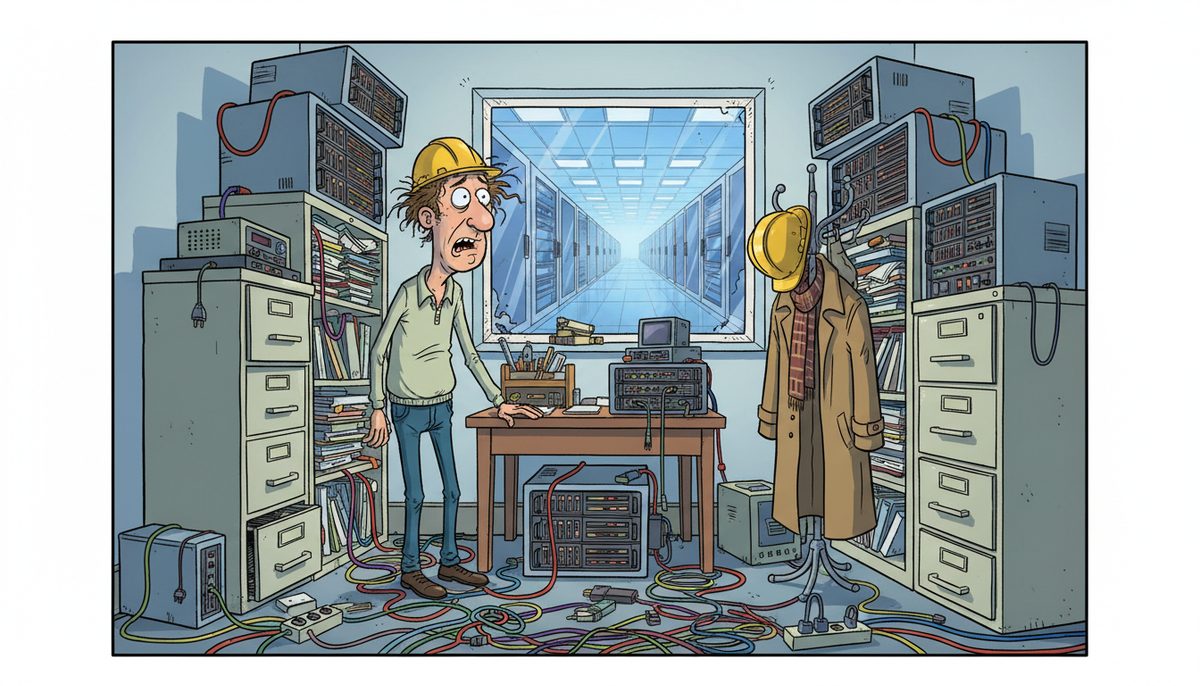
Data center co-location is a service where businesses place their servers and IT equipment in a third-party facility that provides physical space, power, cooling, and network connectivity. Engineering firms typically pay $500 to $3,000 per month per rack or cabinet, gaining enterprise-grade infrastructure without building their own data center. Co-location protects critical CAD files, BIM models, and project deliverables with redundant systems and 24/7 monitoring.
Why do engineering firms consider co-location instead of on-premises servers?
Most engineering offices lack the infrastructure to properly house servers. A single power outage or cooling failure can corrupt drawing sets mid-render or interrupt remote access to project files when subconsultants need them urgently.
Co-location facilities provide redundant power systems with backup generators and uninterruptible power supplies. They maintain precise temperature and humidity controls that prevent hardware failure. Multiple internet service providers ensure your team can access AutoCAD, Revit, and project management systems even if one carrier experiences an outage.
The physical security matters too. Co-location centers use biometric access controls, 24/7 video surveillance, and on-site security staff. Your stamped drawings and proprietary designs stay protected in ways a typical office building cannot match.
For Vancouver Island engineering firms working on remote infrastructure projects—forestry roads, marine facilities, island community developments—reliable connectivity becomes critical. Co-location facilities in Victoria or Nanaimo offer better network infrastructure than most office buildings, with direct connections to multiple fiber providers.
Co-location eliminates the need to maintain server room air conditioning, manage power distribution, or troubleshoot network carrier issues. Your team focuses on engineering work while the facility handles infrastructure.
How does co-location compare to cloud services for engineering workloads?
Cloud services and co-location serve different needs. Cloud platforms like Azure or AWS charge per-use fees that can escalate quickly when you’re moving multi-gigabyte CAD assemblies or rendering 3D models. Co-location provides predictable monthly costs regardless of data transfer volume.
Engineering software licensing often complicates cloud migration. Many CAD and analysis applications require specific hardware configurations or use license servers that work better on dedicated equipment. Co-location lets you run these applications exactly as designed without compatibility concerns.
Data sovereignty matters for firms handling public sector work. When you’re managing projects for BC Ferries, BC Hydro, or provincial government clients, FIPPA requirements mean knowing exactly where data resides. Co-location on Vancouver Island keeps information within Canadian jurisdiction with clear physical location.
Performance differences become obvious with large files. Uploading a 15 GB Civil 3D project to cloud storage might take hours on typical business internet. With co-located servers, your office connects via dedicated circuits or high-speed links, transferring the same files in minutes.
Some firms use hybrid approaches: co-location for file servers and license managers, cloud for email and collaboration tools. This combination delivers speed where it matters while leveraging cloud flexibility for standard applications.
The choice depends on your specific workflow. Firms doing heavy rendering, managing large drawing sets, or running specialized analysis software often find co-location more practical and cost-effective than pure cloud solutions.
What infrastructure requirements should engineering firms evaluate in co-location facilities?
Power redundancy comes first. Look for facilities with N+1 or 2N power configurations, meaning backup systems for every critical component. Ask about generator fuel capacity—can the facility run for days during extended outages? Vancouver Island’s earthquake risk makes this particularly important.
Cooling capacity affects equipment lifespan and performance. Facilities should maintain temperatures between 18-27°C with humidity controls. Hot aisles and cold aisles should be properly separated. Inadequate cooling causes servers to throttle performance or fail during intensive rendering jobs.
Network connectivity determines how quickly your team accesses files. Multiple carriers provide redundancy if one experiences fiber cuts. Ask about available bandwidth options and whether you can upgrade as project demands increase. Direct connections to major internet exchanges reduce latency.
Physical security protects intellectual property. Biometric access, man-trap entries, video surveillance, and on-site staff prevent unauthorized access to your equipment. Individual cabinet locks add another layer when multiple clients share rack space.
Fire suppression systems should use clean agents that won’t damage equipment. Water-based sprinklers destroy servers. Look for FM-200, Novec 1230, or similar systems designed for electronics.
Compliance certifications matter for firms handling sensitive projects. SOC 2 Type II audits verify security controls. SSAE 18 reports document operational procedures. These certifications become important when bidding on government contracts or working with clients who require documented security measures.
Remote hands services let facility staff handle basic tasks like rebooting servers or swapping failed drives. This saves trips to the data center for routine maintenance. Some facilities offer smart hands services for more complex tasks.
Key infrastructure checklist for engineering firms
- Redundant power systems with N+1 or 2N configuration
- Backup generators with multi-day fuel capacity
- Precision cooling maintaining 18-27°C temperature range
- Multiple carrier network connections for redundancy
- Biometric access controls and 24/7 surveillance
- Clean agent fire suppression systems
- SOC 2 Type II or SSAE 18 compliance certifications
- Remote hands and smart hands support services
How does co-location fit with managed IT services for engineering firms?
Co-location provides the physical infrastructure, but someone still needs to manage the servers, apply security patches, monitor performance, and handle backups. This is where managed IT services for engineering firms become essential.
DataStream Networks provides live local support for co-located equipment without the phone trees or overseas technicians common with large providers. When a server needs attention, you reach someone who understands engineering workflows and can respond immediately.
Remote monitoring catches issues before they affect your team. If a hard drive shows early failure signs, technicians can schedule replacement during off-hours. If backup jobs fail, you get alerted immediately rather than discovering the problem when you need to restore files.
Security management becomes more complex with co-located servers. Firewalls need configuration updates, intrusion detection systems require monitoring, and security patches must be tested before deployment. Managed services handle this ongoing work while you focus on project deliverables.
Marla Daniels, working in financial services, experienced this firsthand: “Working with DataStream has been a game-changer for our mortgage broker business. Their quick response times and seamless service have truly revolutionized the way we operate. With DataStream, our entire team is now working together more efficiently than ever, all while ensuring our data is protected and secure.” The same principles apply to engineering firms—reliable support eliminates technology frustrations.
For Vancouver Island firms, having local technicians matters. If remote resolution isn’t possible, DataStream automatically dispatches on-site technicians from Victoria, Nanaimo, or Duncan. You’re not waiting for someone to fly in from the mainland.
The combination of co-location infrastructure and proactive managed services delivers enterprise-grade reliability without requiring in-house IT staff with data center expertise.
What cost factors determine whether co-location makes financial sense?
Co-location pricing typically includes several components. Cabinet or rack space rental runs $500 to $3,000 monthly depending on size and facility tier. Power consumption adds charges based on circuit amperage—a typical engineering server setup might use 3-5 amps at 208V.
Network connectivity costs vary widely. A 100 Mbps connection might cost $200-500 monthly, while 1 Gbps circuits run $1,000-3,000. Cross-connects to specific carriers add $50-200 per connection. Bandwidth overages can surprise you if contracts include transfer limits.
Compare these costs against building and maintaining your own server room. Commercial-grade UPS systems cost $5,000-15,000. Proper cooling requires dedicated HVAC units at $3,000-10,000 plus ongoing electricity costs. Generator backup adds another $10,000-50,000. Fire suppression, security systems, and monitoring equipment add thousands more.
Staff time represents hidden costs. Someone needs to manage physical infrastructure, coordinate with power companies during maintenance, troubleshoot cooling issues, and handle carrier problems. These tasks distract from engineering work or require hiring dedicated IT staff.
Engineering firms with 3-4 servers typically break even on co-location within 18-24 months compared to building equivalent in-house infrastructure.
The calculation shifts for very small firms. If you’re running a single server with basic needs, cloud services or managed IT services with hosted solutions might cost less. Co-location makes most sense when you have multiple servers, specialized hardware requirements, or large data volumes that make cloud storage expensive.
Consider growth trajectory too. Co-location scales easily—add another server to your existing cabinet without infrastructure upgrades. Building your own server room requires oversizing capacity for future growth, paying upfront for space you won’t use for years.
For firms handling public sector work on Vancouver Island, factor in compliance costs. Meeting FIPPA requirements for data handling becomes simpler when you can point to a certified facility with documented security controls rather than explaining your office server room setup.
How do engineering firms handle disaster recovery with co-located equipment?
Co-location improves disaster recovery by separating your infrastructure from your office. If fire, flood, or earthquake damages your building, servers remain operational in the data center. Your team can work remotely while the office is rebuilt.
Vancouver Island’s seismic risk makes geographic separation particularly valuable. The Cascadia Subduction Zone threatens major earthquake and tsunami damage to coastal areas. A co-location facility on higher ground or in a different municipality provides protection your office building cannot.
Backup strategies become more robust with co-located servers. You can implement 3-2-1 backup rules: three copies of data, on two different media types, with one copy off-site. Co-located servers serve as the primary and secondary copies, with cloud or tape backups as the third layer.
Network redundancy matters during disasters. If your office internet fails, staff can work from home or temporary locations while accessing files on co-located servers. Multiple carrier connections at the data center prevent single points of failure.
Testing disaster recovery becomes practical with co-location. Schedule drills where staff work entirely from remote locations, accessing only co-located resources. These tests reveal gaps in your plans before real emergencies occur. DataStream’s field crew file access support ensures remote workers can reach project files reliably.
Professional liability protection connects to disaster recovery. If you cannot deliver stamped drawings on schedule because servers failed, clients may pursue claims. Co-location’s redundant infrastructure reduces this risk significantly.
Backup and recovery services add $25-$75 per device monthly for local backup, or $100-$300 for full managed server backups with testing. These costs protect against data loss that could end an engineering practice.
Document your disaster recovery plan for insurance purposes and client requirements. Many public sector RFPs now ask how firms protect project data and ensure business continuity. Co-location provides concrete answers to these questions.
What security considerations apply to co-located engineering data?
Physical security at co-location facilities exceeds what most engineering offices can provide. Biometric access controls, man-trap entries, and 24/7 video surveillance prevent unauthorized physical access to servers. Individual cabinet locks add another layer when sharing rack space.
Network security requires careful configuration. Your co-located servers sit on shared facility networks, so proper firewall rules become critical. Segment engineering data from other systems. Use VPNs for all remote access to prevent eavesdropping. Implement intrusion detection to catch unauthorized access attempts.
Encryption protects data in transit and at rest. TLS certificates secure connections between offices and co-located servers. Full-disk encryption protects against physical theft of drives. Encrypted backups ensure data remains protected even if backup media is lost.
Engineers and Geoscientists BC regulations require protecting client information and proprietary designs. Co-location facilities with SOC 2 certifications demonstrate documented security controls that satisfy professional practice requirements.
PIPEDA governs how engineering firms handle private sector client data. FIPPA applies to public sector projects. Both require knowing where data resides and who can access it. Co-location provides clear answers: data stays in a specific Canadian facility with documented access controls.
Access logging tracks who accessed servers and when. These audit trails become important if security incidents occur or if clients question data handling. Facility logs combined with server logs create comprehensive records.
Vulnerability management continues even with co-located equipment. Security patches must be tested and deployed regularly. Outdated software creates entry points for attackers. Managed security services handle this ongoing work, monitoring for threats and responding to incidents.
Consider cyber insurance requirements too. Insurers increasingly ask about data protection measures. Co-location in certified facilities with documented security controls may reduce premiums or improve coverage terms.
Frequently asked questions
Can I visit my co-located servers whenever needed?
Most co-location facilities provide 24/7 access with advance notice, though some require scheduling during business hours. You receive access credentials and can visit for maintenance, upgrades, or troubleshooting. Facilities log all access for security purposes. Some providers charge fees for frequent visits or require escorts for non-technical staff entering secure areas.
What happens if the co-location facility loses power?
Facilities use uninterruptible power supplies that instantly switch to battery backup during outages, then start diesel generators within seconds. Generators can run for days with on-site fuel storage and refueling contracts. Redundant systems mean backup components exist for every critical element. Your servers continue operating without interruption during power failures affecting the surrounding area.
How do I connect my office to co-located servers?
Most firms use dedicated internet circuits, VPN connections over business internet, or direct fiber connections between office and data center. Dedicated circuits provide guaranteed bandwidth and lower latency for large file transfers. VPNs over standard internet cost less but may experience variable performance. Direct fiber offers the best performance but costs more and requires fiber availability between locations.
What happens if I outgrow my co-location space?
Facilities typically offer expansion options within the same data center. You can add cabinet space, increase power allocation, or upgrade network connectivity as needs grow. Some contracts include flexibility to scale up or down with notice periods. Planning for growth when initially contracting helps ensure space availability and may secure better pricing terms for future expansion.
Do I need co-location if I already use cloud services?
Many engineering firms use hybrid approaches combining cloud and co-location. Co-location works well for file servers, license managers, and applications requiring specific hardware or high-performance local access. Cloud services handle email, collaboration tools, and applications that benefit from global accessibility. The combination delivers flexibility while controlling costs for data-intensive engineering workloads that perform poorly in pure cloud environments.