
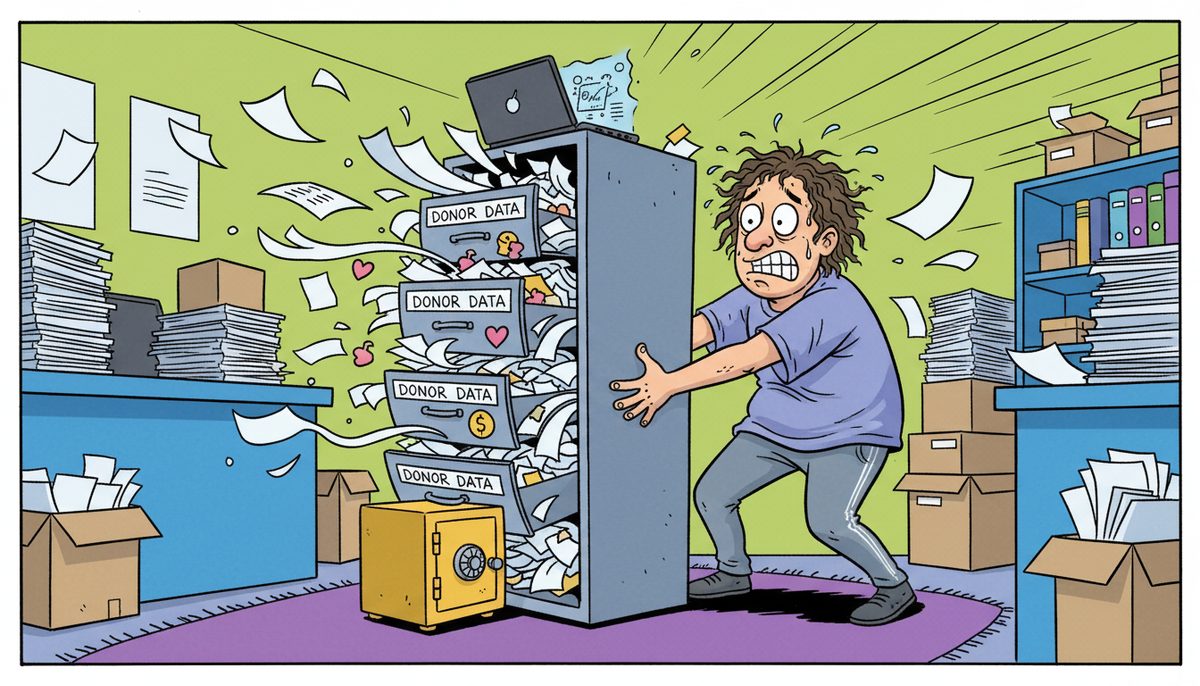
Your non-profit must implement reasonable security safeguards under PIPEDA (or BC’s stricter PIPA legislation), including encrypted data storage, access controls, secure backup systems, and breach response protocols. BC nonprofits face mandatory breach reporting within 72 hours and specific donor credit card data protection rules that apply even to small charities processing fewer than 50 transactions annually, with higher standards than federal requirements.
Your donor management system holds credit card numbers, addresses, donation histories, and sometimes sensitive beneficiary information. When that system crashes three days before your year-end mail drop, you’re not just losing donation processing time—you’re facing the reality that your backup strategy might not meet the legal standards required to protect the people who trust you with their information.
What personal information triggers PIPEDA requirements for non-profits?
You collect personal information the moment you accept a donation with a name attached. Donor names, addresses, email addresses, phone numbers, donation amounts, and credit card details all fall under PIPEDA’s definition of personal information requiring protection.
Beneficiary data creates even higher obligations. If you serve vulnerable populations—youth programs, mental health services, housing support, food banks—you’re handling information about people’s circumstances, needs, and sometimes health conditions. This data requires stronger safeguards than standard donor records.
Volunteer records, board member contact information, and employee files also count. Your volunteer coordinator’s spreadsheet with emergency contacts and availability schedules is personal information under the law. The board package with home addresses distributed before your governance meeting requires the same protection as your donor database.
BC’s PIPA applies to any nonprofit handling BC resident data, even if your organization is federally incorporated or operates nationally.
Email lists represent another obligation many nonprofits overlook. Your newsletter subscribers gave you their contact information for a specific purpose—receiving updates about your mission. Using that list for a different purpose, or failing to protect it from unauthorized access, violates the consent principle at PIPEDA’s core.
Grant applications often require you to collect personal information from program participants to demonstrate impact. Those intake forms with demographic data, income verification, or service utilization details create legal obligations that survive long after the grant period ends.
What security safeguards does PIPEDA require your non-profit to implement?
Reasonable security safeguards scale to the sensitivity of the information you hold and the size of your organization. A small community group with a mailing list faces different requirements than a health-focused charity processing credit card donations and client medical histories.
Access controls form your first line of defense. Not every volunteer needs access to your complete donor database. Your event coordinator needs attendee lists, not credit card numbers. Your program manager needs participant information, not board member home addresses. Role-based access means people see only what they need to do their job.
Encryption protects data both at rest and in transit. Donor information sitting on your server should be encrypted so that even if someone gains unauthorized access, they can’t read the data. Credit card processing must use encrypted connections—that’s the “https” and padlock icon in your browser when donors submit payment information online.
Password policies matter more than most nonprofits realize. “Charity2023” protecting your donor management system won’t satisfy PIPEDA’s reasonable safeguards standard. Multi-factor authentication adds a second verification step that stops most unauthorized access attempts, even when passwords are compromised.
Regular software updates close security vulnerabilities. When your donor management software vendor releases a security patch, delaying installation leaves known vulnerabilities open. Cybercriminals specifically target outdated systems because the vulnerabilities are publicly documented and easy to exploit.
Physical security extends to devices and paper records. Laptops with donor data need encryption and screen locks. Filing cabinets with beneficiary intake forms need to be locked when your office is unattended. USB drives with financial records for your CRA audit can’t sit in an unlocked desk drawer.
Carrie from a utilities organization describes the comprehensive approach needed: “Not only do they provide timely service but they are able to interpret my request and ensure all the related requirements are met as well.” That attention to related requirements—not just the immediate problem—is exactly what PIPEDA compliance demands.
Security safeguards must be documented. BC Gaming grant applications increasingly ask for your cybersecurity policies. United Way and community foundation applications want to see your data protection procedures. You need written policies that describe what safeguards you’ve implemented and how you maintain them.
What backup and recovery systems meet CRA and PIPEDA standards?
The Canada Revenue Agency requires registered charities to maintain books and records for six years. Those records must be accessible when CRA requests them during an audit. “Our backup system failed eight months ago” doesn’t satisfy this legal obligation, and it can cost you your charitable status.
Daily automated backups protect against the most common data loss scenarios. Your development coordinator accidentally deletes last quarter’s donation records. Ransomware encrypts your files and demands payment. A power surge damages your server. Without recent backups, you’re reconstructing months of work from paper receipts and bank statements—if you can reconstruct it at all.
Offsite backup storage protects against physical disasters. Fire, flooding, or theft at your office shouldn’t destroy both your primary data and your backup copies. Cloud backup services store encrypted copies of your data in geographically separate data centers, ensuring you can recover even if your building becomes inaccessible.
Testing your recovery process reveals whether your backups actually work. Many nonprofits discover during a real crisis that their backup system was misconfigured, incomplete, or corrupted. Quarterly recovery tests—actually restoring files from backup to verify they’re readable and complete—catch these problems before they become disasters.
Retention schedules balance legal requirements with privacy principles. PIPEDA requires you to destroy personal information when it’s no longer needed for the purpose it was collected. Keeping donor data forever “just in case” violates this principle. CRA’s six-year requirement for financial records provides a clear retention standard for donation-related information.
Backup systems must include your donor management database, financial records, program documentation, email archives, and policy documents. Your grant agreement with specific reporting requirements, your board meeting minutes documenting governance decisions, and your volunteer agreements all need protection.
Encryption applies to backups just as it does to primary data. An unencrypted backup stored in the cloud or on a portable drive represents the same privacy risk as unencrypted primary storage. If the backup is stolen or accessed without authorization, you face the same breach notification obligations.
How do you handle a data breach under PIPEDA and PIPA?
A data breach occurs when personal information is accessed, disclosed, or lost without authorization. Your volunteer coordinator’s laptop stolen from their car is a breach. An email with donor credit card numbers accidentally sent to your entire mailing list is a breach. A cybercriminal accessing your database is a breach.
BC’s PIPA requires breach notification within 72 hours to affected individuals and the BC Privacy Commissioner when there’s a “real risk of significant harm.” Significant harm includes identity theft, financial loss, damage to reputation, or loss of employment opportunities. Donor credit card exposure clearly meets this threshold.
Federal PIPEDA has similar breach notification requirements. You must notify the Privacy Commissioner of Canada, affected individuals, and sometimes other organizations when a breach creates a real risk of significant harm. Failing to report a breach compounds your legal problems significantly.
Your breach response plan should be documented before a breach occurs. Who discovers the breach and who do they notify immediately? Who has authority to make decisions about notification and remediation? What’s your communication template for affected donors? How do you preserve evidence for investigation?
Containment comes first. If unauthorized access is ongoing, stop it. If a misconfigured system is exposing data, take it offline. If an employee’s compromised credentials are being used, disable that account. Every minute of continued exposure increases the harm and your liability.
Investigation determines what information was accessed, how many people are affected, and what harm might result. You can’t properly notify affected individuals without knowing what data was compromised. Your donor whose mailing address was exposed faces different risks than your donor whose credit card number was stolen.
Notification to affected individuals must be clear and actionable. Tell them what information was compromised, when the breach occurred, what you’re doing to prevent recurrence, and what steps they should take to protect themselves. Vague reassurances don’t satisfy legal requirements or maintain donor trust.
Documentation of your breach response protects you during regulatory investigation. The Privacy Commissioner will ask what safeguards you had in place, how you discovered the breach, how quickly you responded, and what you’ve done to prevent similar breaches. Contemporaneous records demonstrate your good faith compliance efforts.
What IT policies and documentation does your non-profit need?
A privacy policy describes how you collect, use, disclose, and protect personal information. PIPEDA requires you to make this policy available to donors, beneficiaries, volunteers, and anyone else whose information you collect. “We keep your information confidential” isn’t sufficient—you need specific commitments about security safeguards, data retention, and individual access rights.
An acceptable use policy tells staff and volunteers what they can and cannot do with your technology systems. Personal use of work computers, prohibited websites, email etiquette, and social media guidelines all belong here. This policy protects both your organization and your people by setting clear expectations.
An incident response plan documents your process for handling security incidents and data breaches. Step-by-step procedures, assigned responsibilities, notification templates, and contact information for legal counsel and IT support ensure you respond quickly and appropriately when problems occur.
A data retention and destruction schedule specifies how long you keep different types of information and how you securely destroy it when retention periods expire. Donor financial records follow CRA’s six-year requirement. Unsuccessful grant applications might be destroyed after one year. Beneficiary service records might be retained for seven years to support program evaluation and future funding applications.
Access control documentation identifies who has access to what systems and data. When an employee leaves or a volunteer’s term ends, you need to know what accounts to disable and what access to revoke. When a board member asks who can see donor credit card numbers, you need a definitive answer.
Vendor agreements address how third-party service providers handle your data. Your donor management software vendor, your email service provider, your cloud backup company, and your payment processor all access personal information on your behalf. Written agreements specifying their security obligations and your right to audit their practices are essential.
These policies don’t need to be complex or lengthy. A ten-page privacy policy written in legal jargon that nobody reads serves you less well than a two-page policy in plain language that your board actually understands and your staff can follow.
When does a small non-profit need professional IT support for compliance?
You need professional support when the consequences of getting it wrong exceed your ability to fix it yourself. A mailing list breach might cost you donor trust and volunteer time to rebuild your list. A credit card data breach costs you legal fees, regulatory penalties, mandatory credit monitoring for affected donors, and potentially your charitable status when the resulting financial strain prevents you from meeting CRA’s disbursement quota.
Technology complexity outpaces volunteer capability faster than most nonprofits recognize. Your board member who “knows computers” can probably set up email and install software. They likely cannot configure encrypted backups with offsite replication, implement role-based access controls across multiple systems, or respond to a ransomware attack while preserving evidence for law enforcement.
Grant requirements increasingly mandate professional IT practices. BC Gaming grant applications ask about your cybersecurity measures. United Way partnership agreements require data protection attestations. Community foundation grants for capacity building expect you to demonstrate appropriate technology safeguards for the funding level you’re requesting.
The cost of professional support is predictable; the cost of a breach is catastrophic. Managed IT services typically run $150–$225 per user per month, covering help desk support, security monitoring, backup management, and compliance assistance. A single data breach easily costs tens of thousands in legal fees, notification expenses, and remediation—money that comes directly out of program delivery budgets.
Local support matters particularly on Vancouver Island. Mainland IT providers mean ferry delays when you need urgent help. When your donor system crashes during your December campaign and every hour of downtime costs you donations, waiting for a technician to catch the ferry from Vancouver isn’t acceptable.
When your year-end campaign is processing peak donation volume and your payment system throws an error, you need someone who answers immediately and fixes the problem before donors give up and close their browser. Live people answer phones with no voicemail or phone trees, and most problems are fixed remotely within minutes.
Local Vancouver Island technicians in Victoria, Nanaimo, Duncan, and Cobble Hill mean no ferry waits when on-site support is needed. Started in 2012 serving Vancouver Island organizations, the team has seen the specific challenges nonprofits face with grant deadlines, campaign timing, and limited budgets.
Melissa, another client, puts it simply: “Great company to work with, highly recommend for anyone looking for an IT provider.” That straightforward recommendation reflects the experience of working with people who understand your urgency and your constraints.
Here’s how to get your non-profit’s IT compliance in order:
- Call (250) 929-0745 to talk to a real Victoria technician immediately about your current donor data protection, backup systems, and compliance gaps—no voicemail or phone trees, just a conversation about where you are and what needs attention first.
- Get a clear assessment of what safeguards you need for the types of information you handle, from donor credit cards to beneficiary records, with specific recommendations for backup systems, access controls, and breach response procedures that fit your budget and your team’s capabilities.
- Implement the priority fixes first—automated encrypted backups, access controls for sensitive data, and documented policies for grant applications—then build out comprehensive protection as your capacity and funding allow, with ongoing support when systems break or questions arise.
Your donors trust you with their personal information because they believe in your mission. Protecting that information isn’t just a legal obligation—it’s a fundamental part of the stewardship relationship that makes your work possible.
When your systems work reliably and your data is protected, you focus on program delivery instead of technology crises. You submit grant applications confidently with required cybersecurity attestations already in place. You process year-end donations smoothly through December without system crashes interrupting your most critical revenue period.
You sleep soundly knowing that sensitive beneficiary information meets PIPA standards, with breach response procedures documented and tested. Your board asks about program outcomes instead of IT problems. Your staff spends time serving your mission instead of recreating lost data or explaining to donors why their credit card information might have been compromised.
That’s what appropriate IT support delivers for nonprofits: the capacity to focus on the work that matters, protected by systems that work reliably and meet the legal standards required to maintain the trust your mission depends on.
Call (250) 929-0745 to talk to a real technician now about getting your donor data protection and backup systems where they need to be, or visit our Victoria IT support page to learn more about local support for Vancouver Island nonprofits.
Frequently asked questions
Does PIPEDA apply to non-profit organizations in BC?
BC’s Personal Information Protection Act (PIPA) applies to nonprofits operating in British Columbia, not federal PIPEDA. PIPA requirements are stricter than PIPEDA, including mandatory breach notification within 72 hours and specific standards for donor credit card data protection. Even federally incorporated nonprofits must comply with PIPA when handling BC resident information, regardless of organizational size or transaction volume.
What happens if a non-profit has a data breach?
You must notify affected individuals and the BC Privacy Commissioner within 72 hours if the breach creates real risk of significant harm, such as donor credit card exposure or beneficiary record disclosure. Failure to report compounds legal liability significantly. You must contain the breach immediately, investigate what data was compromised, document your response, and implement safeguards to prevent recurrence while managing donor communication and potential regulatory investigation.
How long must non-profits keep donor records under PIPEDA?
CRA requires registered charities to maintain financial records including donation documentation for six years from the end of the tax year they relate to. After this retention period, PIPEDA’s privacy principles require you to securely destroy personal information no longer needed for its original purpose. Keeping donor data indefinitely without a documented business reason violates privacy law, even though many nonprofits default to permanent retention.
What IT security is required for small non-profits with limited budgets?
Reasonable security safeguards scale to information sensitivity and organizational size, but minimum standards include encrypted data storage, role-based access controls, secure password policies with multi-factor authentication, daily automated backups with offsite storage, and documented breach response procedures. Even small nonprofits processing credit card donations or handling beneficiary data must meet these baseline requirements regardless of budget constraints or volunteer-run operations.
Do non-profits need cybersecurity insurance for PIPEDA compliance?
Cyber liability insurance is not legally required but increasingly prudent as breach notification costs, legal fees, and credit monitoring expenses for affected donors can easily exceed $50,000 for even small incidents. Many insurers now require documented security policies, regular backups, and multi-factor authentication as coverage prerequisites. Grant funders and community foundations increasingly expect nonprofits to carry appropriate insurance as part of risk management and governance standards.