Monthly recurring revenue (MRR) is the predictable subscription-based pricing model where you pay a fixed monthly fee per user or device for IT services instead of unpredictable hourly bills. For manufacturing businesses, this typically ranges from $150–$225 per user/month for managed IT, making your production technology costs consistent and budgetable while ensuring your ERP, SCADA, and shop floor systems stay operational.
Why do manufacturing IT costs keep surprising you mid-quarter?
You approve a technology budget in January. By March, you’re explaining to ownership why IT spending is 40% over because your ERP system needed emergency fixes, a CNC machine lost network connectivity during a production run, or ransomware hit your production scheduling system.
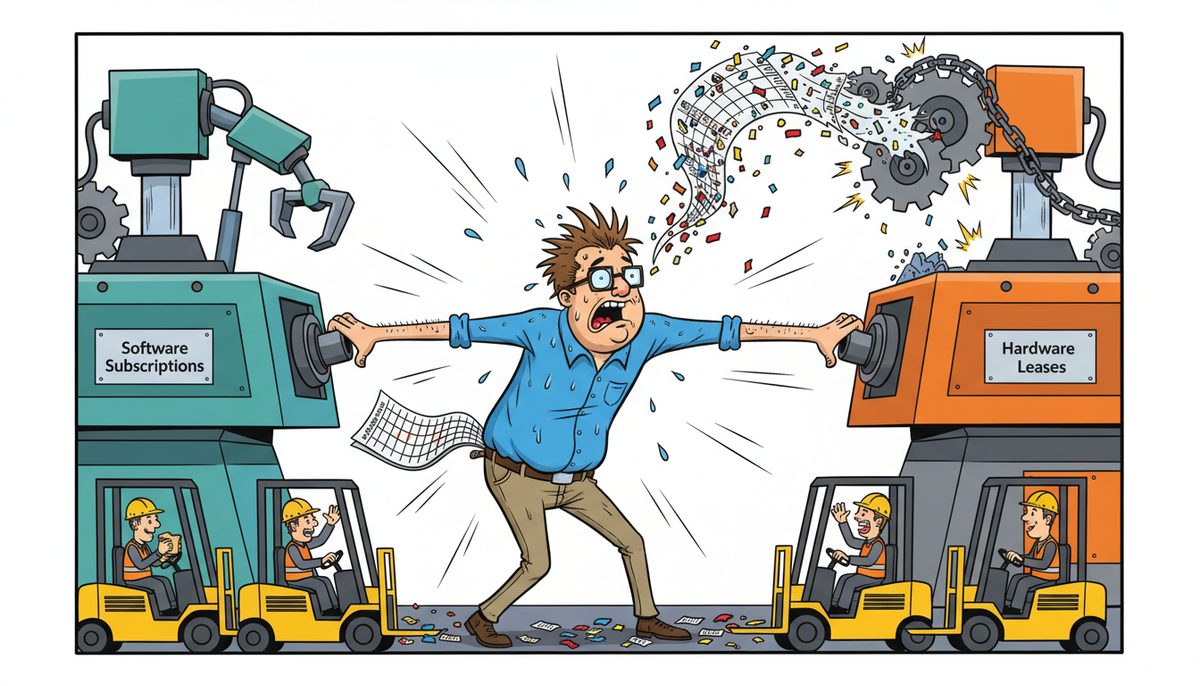
The villain here is unpredictable break-fix billing. When you pay IT providers by the hour, every production emergency becomes a budget negotiation. Your SCADA network fails at 2 PM, halting your production line. Do you authorize expensive emergency rates to fix it now, or wait until regular hours while machine uptime tanks and shipment deadlines slip?
Island manufacturers face this worse than mainland competitors. When your IT provider is in Vancouver, every on-site visit includes ferry time and travel charges. A two-hour fix becomes a six-hour invoice because the technician spent four hours traveling.
You’re left making impossible choices: protect this month’s budget or protect this week’s production schedule. Neither option feels right because manufacturers shouldn’t have to choose between financial predictability and keeping their shop floor running.
What exactly is monthly recurring revenue in manufacturing IT?
Monthly recurring revenue is the subscription model where your IT costs are fixed and predictable. Instead of paying $40–$70 per hour every time something breaks, you pay a set monthly amount per user or per device.
For manufacturing businesses, MRR typically covers your complete technology environment. Your ERP system monitoring, network infrastructure supporting CNC machines and PLCs, data backup protecting CAD files and production data, security defending against ransomware, and help desk access when work orders won’t print or your MES system freezes.
The per-user model charges based on how many employees need technology support. If you have 15 office staff managing production scheduling, inventory, and quality control, plus 8 shop floor supervisors using tablets or HMIs, that’s 23 users. At $150–$225 per user/month for managed IT services, your monthly cost is $3,450–$5,175 regardless of how many problems occur.
The per-device model charges based on servers, workstations, and sometimes industrial equipment connected to your network. Your ERP server might cost $100–$300/month for full managed backups. Each workstation running CAD software or accessing your MES costs $40–$100/month for cybersecurity protection.
MRR shifts IT from an unpredictable expense to a fixed operational cost, like your lease or insurance. You know exactly what technology will cost next month, next quarter, and next year.
How does MRR change what you actually get for manufacturing IT support?
Under hourly billing, your IT provider makes more money when things break. Every server crash, every network outage, every ransomware infection generates billable hours. The incentive structure rewards reactive firefighting, not prevention.
MRR flips this completely. Your provider now makes the same revenue whether your systems fail constantly or run flawlessly. Suddenly, their financial interest aligns with yours: keep everything working so they’re not spending unbillable time fixing problems.
This changes the service model fundamentally. Monitoring becomes standard because catching a failing hard drive before it crashes your production database costs the provider nothing extra but saves them hours of emergency restoration work.
Security updates happen consistently because preventing ransomware is cheaper for the provider than recovering your encrypted CAD files and production schedules. Backup testing becomes routine because restoring from verified backups takes minutes while rebuilding corrupted data takes days.
For Vancouver Island manufacturers, MRR eliminates the travel-time penalty. When you’re paying monthly regardless, your provider can dispatch a technician from Victoria, Duncan, or Nanaimo to your facility without negotiating ferry time and mileage charges. The technician arrives faster because there’s no billing friction.
Carrie Wong, who manages technology for a Vancouver Island utilities operation, describes the result: “All of DataStream’s team is highly personable. Not only do they provide timely service but they are able to interpret my request and ensure all the related requirements are met as well. They are great at follow-up too.” When IT costs are predictable, providers focus on solving the full problem instead of minimizing billable time.
What happens to your production schedule if you stay on hourly IT billing?
Your ERP system crashes during second shift. Production supervisors can’t access work orders. The shop floor keeps running on yesterday’s schedule, but you’re building the wrong components for tomorrow’s shipment.
You call IT support at 10 PM. Voicemail. You try the emergency number. Someone answers but explains after-hours rates are $150/hour with a four-hour minimum, plus travel time from Vancouver if remote access doesn’t work. You’re looking at $600 minimum, possibly $1,200 if they need to catch the morning ferry.
Do you authorize it tonight or wait until morning? Either choice costs you. Authorize it now and you’re explaining the emergency IT bill in next week’s budget meeting. Wait until morning and you’ve lost 8 hours of production time, missed a shipment deadline, and you’re calling your customer to explain why island geography makes your delivery less reliable than mainland suppliers.
This scenario repeats differently each quarter. A SCADA network issue. A ransomware infection. A failed backup discovered during an audit. Each incident forces the same impossible calculation: protect the budget or protect production.
Your OEE numbers suffer because you’re making technology decisions based on accounting instead of operational need. Machine uptime becomes secondary to cost avoidance. Your production efficiency drops not because equipment fails, but because you’re rationing IT support to control spending.
Meanwhile, your competitors on predictable MRR contracts fix problems immediately without budget negotiations. They’re shipping on time while you’re explaining delays.
How do you calculate the right MRR investment for manufacturing IT?
Start with your user count. Count everyone who touches technology: office staff managing ERP and production scheduling, shop floor supervisors using tablets or HMIs, quality control teams accessing MES systems, engineering staff running CAD/CAM software.
Don’t count machine operators who only interact with a single CNC control panel. Do count anyone who logs into Windows, accesses email, or uses networked applications.
Multiply your user count by $150–$225 per month for managed services. A 20-user manufacturing facility pays $3,000–$4,500 monthly for complete IT support including help desk, security, backup, and monitoring.
Add device-specific costs for critical infrastructure. Your ERP server needs $100–$300/month for full managed backups with recovery testing. Industrial PCs running SCADA or MES might need $40–$100/month for cybersecurity protection if they’re network-connected.
Compare this total to your current annual IT spending. Pull last year’s invoices: hourly support calls, emergency after-hours fixes, project work, software licensing, backup services. Divide by 12 for your actual monthly average.
Most manufacturing businesses discover they’re already spending MRR-equivalent amounts, but unpredictably. Three months might be $1,500 each, then one $8,000 month when the ERP server failed, then two $2,000 months for various fixes. The average is $4,000/month, but the variance makes budgeting impossible.
MRR converts that $4,000 average into $4,000 every month. Same annual cost, zero surprises, and better service because prevention replaces reaction.
Factor in compliance requirements. PIPEDA and BC PIPA mandate data protection for customer and employee information. WorkSafeBC has technology requirements for industrial environments. If you’re exporting, Canadian export controls affect how you handle technical data. Compliance services cost $1,000–$5,000 as one-time projects, but ongoing compliance monitoring is usually included in managed services MRR.
A 25-user manufacturing facility typically invests $4,000–$6,000 monthly in MRR-based IT, covering all users, servers, security, backup, and compliance—equivalent to one emergency ERP recovery project under hourly billing.
When does a local IT partner make MRR more valuable for island manufacturers?
MRR pricing is available from mainland providers and Vancouver Island companies alike. The difference for manufacturers isn’t the pricing model—it’s what happens when the monthly fee needs to turn into actual support during a production emergency.
You need someone who understands that “the network is down” means different things in manufacturing than in an accounting office. When your SCADA system loses connectivity, that’s not just inconvenient email access—that’s real-time production monitoring gone dark, with operators making decisions blind.
You need technicians who can reach your facility in Victoria, Duncan, or Nanaimo without ferry schedules turning a 30-minute drive into a 4-hour journey. Island geography shouldn’t determine whether you meet shipment deadlines.
You need someone who answers the phone immediately when your ERP crashes mid-shift, not voicemail promising a callback “within 4 business hours” while your production schedule falls apart.
DataStream Networks has served Vancouver Island manufacturers since 2012 with local technicians in Victoria, Nanaimo, Duncan, and Cobble Hill. When you call, a real person answers—no voicemail, no phone tree, no overseas call center reading scripts about rebooting your computer while your CNC machines sit idle.
Most problems get fixed remotely within minutes because the technicians understand manufacturing systems and production urgency. When remote resolution isn’t possible, a technician is dispatched to your facility without ferry delays or travel-time negotiations eating into your MRR budget.
The MRR model works when the provider’s incentives match yours. You want production running. They want to solve problems efficiently without generating extra billable hours. Local presence means they can deliver on that promise when your shop floor needs it, not when the ferry schedule allows it.
Here’s how predictable IT costs protect your production schedule:
- Call (250) 929-0745 and talk to a real local technician immediately who understands manufacturing systems—no voicemail or phone trees delaying your production recovery.
- Get your ERP, SCADA, or network problem diagnosed and fixed remotely within minutes in most cases, or have a technician dispatched to your Vancouver Island facility without ferry delays.
- Pay the same predictable monthly amount whether you call once or twenty times, so production decisions are based on operational need, not budget negotiations.
What does manufacturing success look like with predictable IT costs?
Your production schedule runs on operational logic, not IT budget availability. When your MES system freezes during a production run, you call immediately because there’s no hourly meter running. The problem gets fixed in minutes, not hours, because your provider’s local technicians respond without ferry delays.
Your quarterly budget reviews stop including surprise IT overages. Finance sees the same number every month. You can plan equipment investments, hiring, and facility improvements knowing exactly what technology will cost.
Your OEE numbers improve because technology problems get resolved based on production impact, not cost-per-hour calculations. Machine uptime increases. Shipment deadlines get met consistently. Customer relationships strengthen because you’re not explaining delays caused by waiting for IT support.
Your production data, CAD files, and manufacturing designs stay protected with backup systems and security that meet PIPEDA and BC PIPA requirements—not because you approved a special project, but because it’s included in your monthly service.
Your shop floor keeps running because the technology supporting it gets the same priority as the machines themselves. Both are operational costs. Both are predictable. Both are essential.
Call (250) 929-0745 to talk to a real technician about converting your unpredictable IT costs into a fixed monthly investment that protects your production schedule instead of threatening it.
Frequently asked questions
What’s included in the monthly recurring revenue for manufacturing IT?
Comprehensive MRR at $150–$225 per user/month typically includes help desk support, monitoring of your ERP and network infrastructure, data backup and recovery, cybersecurity protection, email security, and remote problem resolution. Server backups, compliance support, and specialized industrial system monitoring may cost additional per-device fees depending on your manufacturing environment and equipment connectivity.
Can I still get on-site support with a monthly recurring revenue model?
Yes, MRR contracts include on-site support when remote resolution isn’t possible. Local Vancouver Island providers can dispatch technicians to your facility in Victoria, Duncan, or Nanaimo without ferry delays or additional travel charges. The monthly fee covers both remote and on-site support, eliminating the billing friction that delays emergency response under hourly models.
How does MRR pricing compare to hiring an in-house IT person for manufacturing?
An in-house IT technician costs $50,000–$80,000 annually plus benefits, providing single-person coverage during business hours only. MRR at $150–$225 per user/month for 20 users ($36,000–$54,000 annually) provides a full team with manufacturing systems expertise, 24/7 monitoring, immediate phone support, and local on-site response—coverage one person can’t match, especially during nights, weekends, or production emergencies.
What happens if my manufacturing IT needs change during the contract?
MRR contracts scale with your business. Add users when you hire production staff or expand operations; the monthly cost adjusts proportionally. Add device coverage when you install new servers or connect additional CNC machines to your network. Most providers adjust monthly billing as your manufacturing environment changes, rather than locking you into fixed counts that don’t match your actual needs.
Does monthly recurring revenue cover compliance requirements for Vancouver Island manufacturers?
Basic compliance monitoring for PIPEDA and BC PIPA data protection is typically included in managed services MRR. Formal compliance projects like gap analysis ($2,500–$10,000) or policy development ($1,500–$7,500) are usually separate one-time costs. Ongoing compliance maintenance—backup verification, security updates, access controls—is covered in your monthly fee once initial compliance is established.