
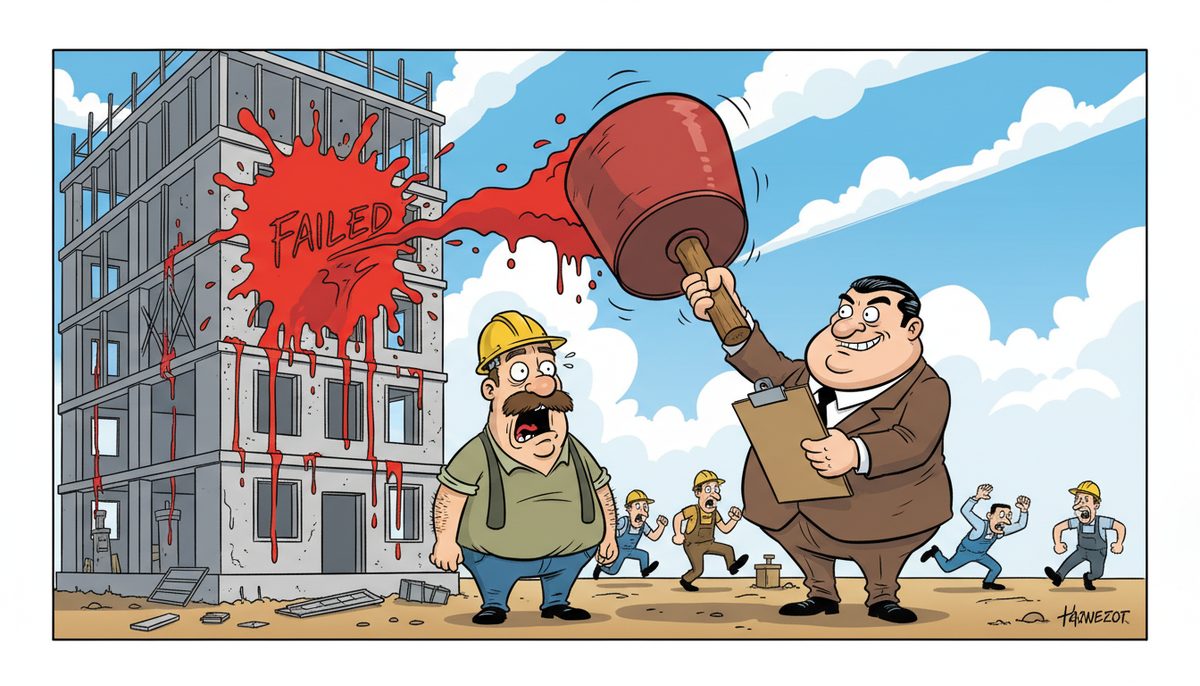
Construction businesses in British Columbia that fail to comply with provincial Occupational Health and Safety regulations face administrative penalties ranging from $1,150 to $747,165 per violation, immediate work stoppages, criminal prosecution under the Criminal Code for serious incidents, and potential director liability. WorkSafeBC can also increase assessment rates, impacting long-term operating costs and competitiveness in public sector bidding.
What are the immediate consequences of an OHS violation on a construction site?
When WorkSafeBC identifies a violation during an inspection or after an incident, officers have authority to issue stop-work orders immediately. Your crew stops working, equipment sits idle, and project timelines collapse while you scramble to demonstrate compliance.
The financial impact starts instantly. A stopped site burns money through idle equipment rentals, crew wages with no productivity, and penalty clauses in your contracts. General contractors face pressure from clients, and subcontractors lose revenue while waiting for clearance to resume.
WorkSafeBC officers require documented evidence of corrective action before lifting stop-work orders. You need to produce safety meeting records, training certificates, equipment inspection logs, and hazard assessments—often within hours. Construction companies without reliable digital systems struggle to locate these documents quickly.
Administrative penalties for high-risk violations in construction can reach $747,165 per incident under BC’s progressive penalty framework.
Beyond the immediate site, your company’s reputation takes a hit. WorkSafeBC publishes enforcement actions online, visible to potential clients reviewing your safety record during procurement processes. Public sector projects in Victoria—hospitals, university buildings, government facilities—require clean safety records as part of tender evaluation.
Stop-work orders create cascading delays that affect every trade on site, not just your crew.
How does WorkSafeBC calculate penalties for construction companies?
WorkSafeBC uses a progressive administrative penalty system that considers violation severity, your company’s compliance history, and the size of your operation. First-time violations for low-risk issues might result in warnings, but repeat offenses or high-risk violations trigger escalating financial penalties.
The penalty structure has three tiers. Low-risk violations (inadequate documentation, minor procedural gaps) start at $1,150. Medium-risk violations (missing fall protection plans, inadequate machine guarding) range from $2,875 to $57,500. High-risk violations (exposed workers to immediate danger, failure to implement critical safety systems) reach $115,000 to $747,165.
Your compliance history multiplies these base amounts. A construction company with previous violations in the past three years faces penalties at 1.5× to 3× the base rate. WorkSafeBC tracks every inspection, warning, and violation in their database—another reason why maintaining your own detailed safety records matters.
Assessment rate increases hit harder over time than one-time penalties. WorkSafeBC adjusts your annual assessment rate based on your claims history and compliance record. A serious violation can increase your rate for years, adding thousands to your annual WorkSafeBC premiums and making your bids less competitive.
Luigi Mansueti, a Victoria construction professional, experienced firsthand how system failures compound compliance challenges: “Our systems were running slow in the past. DataStream installed a new backup system, provided security for our network, and established a roadmap for future projects. DataStream thoroughly cleaned our file sharing, implemented password control, and smoothly transitioned us to take back control of our network.” Reliable IT infrastructure ensures safety documentation remains accessible when WorkSafeBC requests it.
The financial impact extends beyond fines—insurance premiums rise, bonding capacity shrinks, and public sector procurement doors close.
Can construction company directors face personal liability for OHS failures?
Yes. BC’s Workers Compensation Act allows WorkSafeBC to pursue directors and officers personally for violations. Section 217.1 of the Criminal Code imposes a legal duty on anyone who directs work to take reasonable steps to prevent bodily harm, creating potential criminal liability for serious incidents.
Personal liability kicks in when WorkSafeBC determines that directors knew or should have known about unsafe conditions and failed to act. If your superintendent reports fall hazards repeatedly through email and you ignore them, those digital records become evidence of willful neglect.
Criminal charges under the Criminal Code carry penalties up to life imprisonment for criminal negligence causing death. These aren’t theoretical—BC prosecutors have charged construction company executives following workplace fatalities. The Metron Construction case in 2017 resulted in charges against both the company and individual managers.
Due diligence is your defense. Courts look for documented evidence that you implemented safety systems, trained workers, conducted inspections, and responded to hazards. This requires meticulous record-keeping: safety meeting minutes, training attendance, equipment inspection logs, and corrective action tracking.
Your IT systems become your legal protection. When emails, safety reports, and training records disappear due to system failures or inadequate backups, you lose the evidence proving you acted responsibly. Construction companies need reliable data backup and recovery systems to preserve this documentation.
Personal liability means your home, personal assets, and future earnings are at risk—not just company assets.
What documentation must construction companies maintain for OHS compliance?
WorkSafeBC requires construction companies to maintain comprehensive safety documentation for inspection at any time. Missing or incomplete records during an inspection trigger violations even if your actual safety practices are sound.
Mandatory documentation includes written occupational health and safety programs, hazard assessments for each work task, safety meeting records with attendance, training certificates for all workers, equipment inspection logs, and incident investigation reports. For projects over $75,000, you need a formal safety program meeting specific regulatory requirements.
Retention periods matter. You must keep injury records for three years, training records for the duration of employment plus one year, and exposure records (asbestos, silica, noise) for 40 years. These timelines create massive data management challenges for construction companies juggling multiple projects.
Digital systems solve the documentation burden but create new risks. If your server crashes and you can’t produce safety records during a WorkSafeBC inspection, you’re non-compliant regardless of whether the records existed before the crash. Construction companies need robust data backup and recovery solutions to protect this critical documentation.
Victoria’s construction sector faces additional documentation requirements. Heritage building renovations require detailed safety plans for hazardous materials (lead paint, asbestos). Seismic upgrade projects need specialized fall protection documentation. Public sector projects under FIPPA require enhanced privacy controls for worker safety information.
| Document Type | Retention Period | Inspection Frequency |
|---|---|---|
| Safety meeting records | 3 years | Every inspection |
| Training certificates | Employment + 1 year | Every inspection |
| Equipment inspection logs | 3 years | Monthly minimum |
| Incident investigations | 3 years | Within 48 hours of incident |
| Exposure records (asbestos, silica) | 40 years | Annually or as required |
| Hazard assessments | Duration of project | Before each task |
Daryl Wood, a construction professional, emphasizes the stakes: “Considering all the cyber threats facing businesses today, you have to ask, what happens if your systems go down and you can’t operate for several days? If this would cause you big problems, I’d suggest protecting yourself by selecting DataStream as your security partner and get some peace of mind knowing they have it covered.” System downtime during a WorkSafeBC inspection can mean the difference between compliance and costly violations.
Paper records are legally acceptable but practically unmanageable for companies operating across multiple Vancouver Island job sites.
How do OHS compliance failures affect construction company bidding and contracts?
Your WorkSafeBC compliance record directly impacts your ability to win contracts, especially in the public sector. Provincial and municipal procurement processes in Victoria require Certificate of Recognition (COR) certification or equivalent safety documentation as part of bid evaluation.
Public sector projects—university buildings, hospital expansions, government facilities—assign weighted scores to safety records during procurement. A recent violation or elevated assessment rate can disqualify your bid before evaluators even review your pricing. BC Infrastructure Benefits agreements for major projects require clean safety records as a condition of participation.
Private sector clients increasingly request WorkSafeBC clearance letters and compliance histories before awarding contracts. General contractors performing due diligence on subcontractors check safety records to avoid liability exposure. One serious violation can exclude you from preferred vendor lists for years.
Bonding capacity shrinks after OHS violations. Surety companies review WorkSafeBC records when underwriting performance bonds. Serious violations signal management problems, increasing bonding costs or reducing your bonding limit. This caps the size of projects you can bid, limiting growth.
Insurance premiums rise in tandem with WorkSafeBC assessment rates. Commercial general liability insurers consider safety records when pricing policies. A pattern of violations can make coverage unaffordable or unavailable, effectively ending your ability to operate.
The competitive disadvantage compounds over time. While you’re addressing violations and rebuilding your safety record, competitors with clean records capture market share. In Victoria’s construction market—with significant institutional and public sector work—safety record differentiation matters more than in purely private residential markets.
Your safety record is now a competitive advantage, not just a regulatory checkbox.
What role does IT infrastructure play in preventing OHS compliance failures?
Modern OHS compliance depends on digital systems. Construction companies manage safety documentation across multiple job sites, coordinate training schedules, track equipment inspections, and respond to WorkSafeBC requests—all requiring reliable IT infrastructure.
Data backup and recovery systems protect your compliance documentation. When a server fails or ransomware encrypts your files, you need immediate access to safety records to avoid violations during inspections. Construction companies operating across Vancouver Island—from Victoria to Nanaimo to Duncan—need cloud-based backup systems accessible from any location.
Email systems preserve the communication trail proving due diligence. When superintendents report hazards, managers respond to safety concerns, or trainers confirm worker certifications, those emails become legal evidence. Reliable email systems with archiving and spam protection ensure this documentation remains intact and accessible.
Mobile connectivity enables real-time safety reporting from job sites. Field staff photograph hazards, complete digital inspection checklists, and submit incident reports from remote locations. But Vancouver Island’s rural construction sites often have limited cellular coverage, requiring IT solutions that work offline and sync when connectivity returns.
Security solutions protect sensitive worker safety information. BC’s Personal Information Protection Act (PIPA) and FIPPA for public sector projects require construction companies to safeguard worker injury records, exposure data, and training information. Cybersecurity breaches exposing this data create regulatory violations beyond WorkSafeBC compliance.
Help desk services minimize downtime during critical compliance moments. When you’re preparing for a WorkSafeBC inspection or responding to an incident investigation request, you can’t wait days for IT support. Construction companies need local technicians who understand the urgency of compliance deadlines and can restore systems quickly.
For construction companies managing OHS compliance across multiple sites, help desk services ensure safety documentation remains accessible when WorkSafeBC inspectors arrive. Reliable data backup and recovery protects the training records, incident reports, and hazard assessments that prove due diligence and prevent personal liability.
Your IT infrastructure is now part of your safety program, not separate from it.
Frequently asked questions
Can WorkSafeBC shut down my entire construction company for one violation?
WorkSafeBC typically issues stop-work orders for specific activities or sites rather than entire companies. However, systemic violations affecting multiple sites or repeated high-risk violations can result in company-wide orders. Officers assess whether the violation indicates broader management failures. If your safety program is fundamentally inadequate, WorkSafeBC can stop all operations until you demonstrate company-wide corrective action and compliance.
How long do OHS violations stay on my WorkSafeBC record?
WorkSafeBC considers compliance history from the previous three years when calculating progressive penalties. Violations older than three years don’t directly increase penalty multipliers, but serious violations remain in your permanent record and appear in compliance history reports requested by clients. Public enforcement actions published online remain accessible indefinitely, affecting your reputation beyond the three-year penalty calculation window.
What happens if I can’t produce safety records during a WorkSafeBC inspection due to a system failure?
WorkSafeBC expects you to maintain accessible records at all times. System failures don’t excuse non-compliance. Officers may issue violations for inadequate record-keeping even if records existed before the failure. You’re responsible for implementing backup systems ensuring documentation availability. This is why construction companies need robust data backup and recovery solutions protecting safety documentation from hardware failures, cyberattacks, and disasters.
Do small construction companies face the same OHS penalties as large contractors?
WorkSafeBC’s penalty structure considers company size, but all construction companies face the same regulatory requirements. Smaller companies may receive lower penalty amounts for equivalent violations, but the compliance obligations—safety programs, training, documentation—apply regardless of size. Small contractors often struggle more with compliance because they lack dedicated safety staff, making reliable IT systems for documentation management even more critical.
Can I appeal WorkSafeBC penalties and stop-work orders?
Yes. You can request a review of penalties and orders through WorkSafeBC’s Review Division within 90 days. The review process examines whether officers applied regulations correctly and whether penalties are appropriate. However, stop-work orders typically remain in effect during appeals unless you demonstrate immediate compliance. Appeals require documented evidence supporting your position, emphasizing the importance of maintaining detailed safety records.