
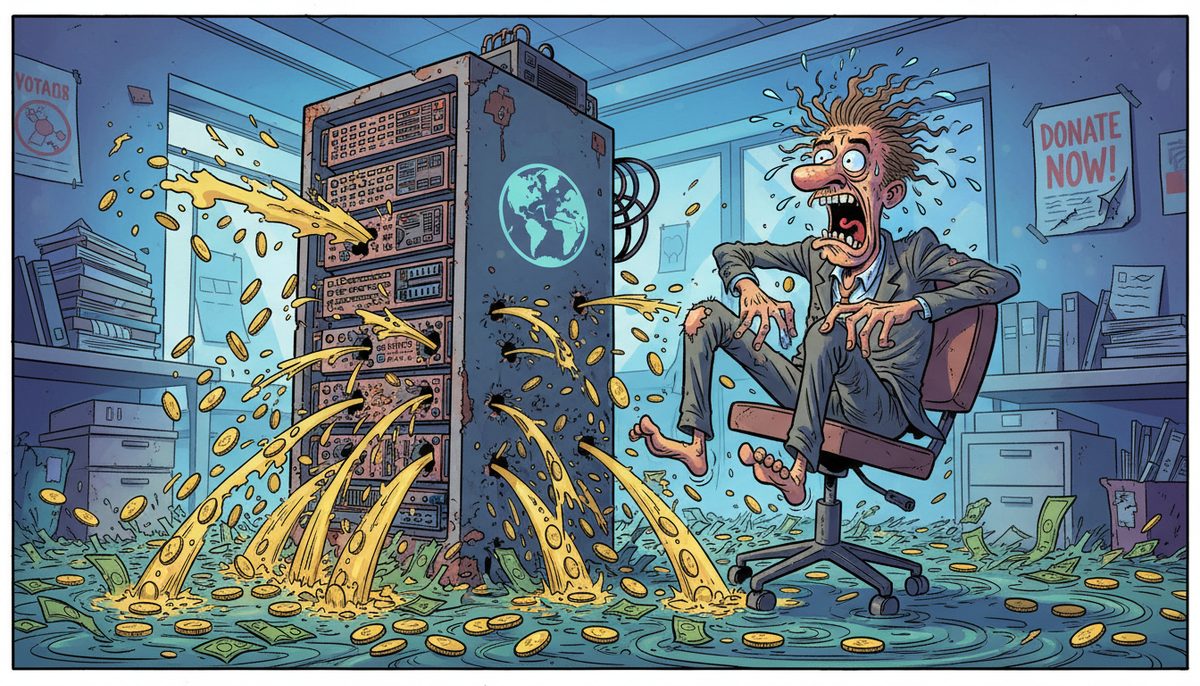
Managed servers save your nonprofit money by eliminating emergency IT bills that average $3,000–$8,000 per incident, preventing donation processing downtime during critical fundraising periods, and ensuring CRA-compliant backups that protect you from audit penalties. Instead of reacting to crises, you pay a predictable monthly cost while professionals monitor your systems 24/7 and fix problems before they impact operations.
Why do nonprofits keep facing unexpected server costs?
Your server sits quietly in a closet or under someone’s desk, doing its job until it doesn’t. Then it crashes during your December donation campaign or right before a BC Gaming grant deadline, and suddenly you’re facing emergency technician fees, overnight hardware shipping, and lost donation revenue while you scramble to find help.
The real problem isn’t the server itself. It’s that nobody’s watching it. Your donor management system, financial records, and volunteer databases all depend on that server, but there’s no IT person checking if the hard drives are failing, if backups are actually running, or if security patches are applied.
You’re running technology the same way you’d drive a car without ever checking the oil—it works fine until catastrophic failure happens all at once. By then, you’re not just paying for repairs. You’re paying emergency rates, losing donation processing time during your most critical revenue period, and potentially facing CRA compliance issues if backup records don’t exist.
Most Victoria nonprofits have experienced at least one server crisis that cost them a grant deadline, donor trust, or thousands in emergency recovery fees. The pattern repeats because reactive IT always costs more than preventive care.
What does server downtime actually cost a nonprofit organization?
When your server goes down three days before your year-end mail campaign, you’re not just facing repair bills. You’re watching donation processing stop during the period that generates 35–40% of annual individual giving for most Canadian charities.
Every hour your donor management system is offline means gift processing delays, receipt generation failures, and donors who give to other organizations instead. If your downtime happens during December, you may never recover that revenue—donors who planned to give $100 before December 31st don’t typically double their gift in January to make up for your technical problems.
The financial damage compounds quickly. Emergency data recovery services start at $2,000 and can exceed $10,000 for severe failures. If you need hardware replacement overnight, you’re paying premium shipping and after-hours technician rates. Meanwhile, your program staff can’t access case files, your finance team can’t process payroll, and your executive director is explaining to the board why technology problems are threatening organizational stability.
Beyond immediate costs, there’s reputational damage. When you can’t process donations reliably or protect donor data properly, you lose the community trust that took years to build. One Victoria nonprofit lost a major corporate sponsor after a data breach exposed donor information—not because of the breach itself, but because they had no backup or security monitoring in place, which the sponsor viewed as negligent stewardship.
A single server failure during fundraising season can cost a small nonprofit $15,000–$40,000 in lost donations, emergency recovery fees, and compliance penalties.
How do managed servers prevent these expensive emergencies?
Managed servers flip the model from reactive to preventive. Instead of waiting for failure, technicians monitor your server’s health continuously—checking hard drive status, memory usage, backup completion, and security vulnerabilities before they become crises.
When a hard drive starts showing early failure signs, it gets replaced during normal business hours at standard rates, not at 9 PM on a Friday for triple the cost. When a security patch is released, it’s tested and applied before hackers exploit the vulnerability. When backups fail, you get an alert the same night, not six months later during a CRA audit when you discover your financial records don’t exist.
This monitoring happens remotely and automatically. You’re not paying someone to sit in your office watching servers. You’re paying for professional oversight that catches problems early, when they’re cheap and easy to fix. Most issues get resolved before you even know they existed.
For Vancouver Island nonprofits specifically, managed servers eliminate the ferry-delay problem. When mainland IT providers need to dispatch a technician, you’re waiting for ferry schedules and paying travel time. With local Victoria technicians monitoring your systems remotely and fixing most problems within minutes, you avoid both the delay and the travel charges.
Managed servers also include systematic backup verification. Your donor database, financial records, and program files get backed up automatically, and those backups are tested regularly to ensure they actually work. When CRA asks for seven years of financial records or United Way requires documentation for a grant application, you have it—immediately and reliably.
What’s the real cost difference between managed and unmanaged servers?
Let’s compare the actual numbers over a typical year for a small Victoria nonprofit with 8–12 staff members and one server running their donor management system and file storage.
| Cost Category | Unmanaged Server (Reactive) | Managed Server (Preventive) |
|---|---|---|
| Monthly base cost | $0 (until something breaks) | $100–$300/month |
| Annual monitoring & maintenance | $0 (nothing scheduled) | Included in monthly fee |
| Backup services | $0–$600 (if remembered) | Included in monthly fee |
| Emergency support calls | $1,200–$4,800 (2–4 incidents/year at $150–$200/hour) | $0 (included) |
| After-hours emergency rates | $800–$2,400 (premium rates) | $0 (monitoring prevents emergencies) |
| Data recovery (every 2–3 years) | $2,000–$10,000 (when backups fail) | $0 (verified backups) |
| Downtime during fundraising | $5,000–$20,000 (lost donations) | $0 (prevented) |
| Annual total | $9,000–$37,800 | $1,200–$3,600 |
The unmanaged approach looks cheaper month-to-month because you’re not paying anything—until you are. Then you’re paying emergency rates at the worst possible time, when your fundraising campaign is live or a grant deadline is tomorrow.
Managed servers cost more predictably but far less overall. You’re spreading the cost of professional IT oversight across twelve months instead of concentrating it into crisis moments when you have no negotiating power and no time to shop around.
For Vancouver Island nonprofits specifically, you’re also eliminating ferry-related travel charges that mainland providers bill. A technician dispatch from Vancouver means you’re paying for their time on the ferry, their vehicle, and potentially overnight accommodation if the problem requires extended on-site work. Local Victoria technicians monitoring your server remotely cost a fraction of that, and when on-site visits are needed, there’s no ferry delay or travel premium.
Managed servers transform IT from an unpredictable budget threat into a known operating expense you can plan for in grant applications and annual budgets.
How do managed servers protect grant funding and charitable status?
CRA requires registered charities to maintain financial records for seven years and produce them on request during audits. If your server crashes and backups don’t exist, you can’t comply. CRA can revoke charitable status for failure to maintain adequate books and records, which means losing the ability to issue tax receipts—essentially ending your organization.
BC Gaming Policy and Enforcement Branch has specific record-keeping requirements for gaming grant recipients. If you receive gaming funds and can’t produce the required financial documentation because of server failure, you’re not just losing future grants—you may need to repay funds already received.
United Way and community foundation grant applications increasingly require cybersecurity attestations and data protection policies. You need to confirm that donor data is backed up, that systems are monitored for security threats, and that you have recovery plans in place. Without verified backups and security monitoring, you can’t honestly complete these attestations, which disqualifies you from significant funding sources.
PIPA (BC’s Personal Information Protection Act) requires nonprofits handling BC resident data to implement reasonable security safeguards. If a data breach occurs and you have no monitoring, no security patches, and no backup verification, you’re facing mandatory breach reporting to the Privacy Commissioner, potential fines, and civil liability from affected donors or beneficiaries.
Daryl, who works in construction, put it clearly: “Considering all the cyber threats facing businesses today, you have to ask, what happens if your systems go down and you can’t operate for several days? If this would cause you big problems, I’d suggest protecting yourself by selecting DataStream as your security partner and get some peace of mind knowing they have it covered. If not, roll the dice. Problems will find you eventually.”
For nonprofits, the stakes are even higher than for-profit businesses. You’re not just protecting revenue—you’re protecting your legal status, your grant eligibility, and the donor trust that makes your mission possible.
Managed servers provide the documented, verified protection that grant applications require and that CRA audits demand. When someone asks if your donor data is backed up and secure, you can answer confidently because professionals are monitoring it daily, not hoping that the backup script you set up three years ago is still running.
How does a local Victoria provider make managed servers more cost-effective?
Geography matters more than most nonprofits realize, especially on Vancouver Island. When your server needs attention and your IT provider is in Vancouver, you’re paying for ferry time, vehicle costs, and travel hours before any actual work begins. A two-hour repair job becomes a six-hour invoice when you factor in the technician’s travel time from the mainland.
Local Victoria technicians eliminate that premium entirely. When remote monitoring catches a problem that requires on-site attention, a technician can be at your office in Duncan, Nanaimo, or Victoria within the hour—no ferry schedules, no travel charges, no waiting until tomorrow because the last sailing already left.
This speed matters during time-sensitive situations. When your donor system crashes three days before a major mail campaign, the difference between a two-hour fix and a next-day fix is thousands of dollars in lost donation processing time. When a BC Gaming grant application is due Friday and your financial records are inaccessible Thursday afternoon, you need help now, not after someone catches the morning ferry.
Local providers also understand Vancouver Island’s specific technology challenges. They know that rural and remote communities you serve often have limited connectivity, that seasonal tourism affects your revenue cycles, and that many of your board members and volunteers expect technology that works simply and reliably without requiring technical expertise they don’t have.
Since 2012, DataStream Networks has focused exclusively on Vancouver Island businesses and organizations, with technicians in Victoria, Nanaimo, Duncan, and Cobble Hill. When you call, you talk to a real person immediately—no voicemail, no phone tree, no overseas call center. Most problems get fixed remotely within minutes, and when on-site visits are needed, technicians are already on the island.
That local presence translates directly to cost savings. You’re not subsidizing someone else’s travel expenses or waiting for ferry-dependent schedules. You’re getting fast, reliable support from people who understand your organization’s constraints and your community’s needs.
What does the transition to managed servers look like?
Moving from unmanaged to managed servers is simpler than most nonprofits expect. You don’t need to replace your existing equipment or migrate to new systems immediately. The process focuses on adding professional oversight to what you already have, then improving things systematically over time.
- Assessment and immediate protection. A technician evaluates your current server setup, identifies urgent vulnerabilities, and implements basic monitoring and backup verification right away. This happens in days, not weeks. You get immediate protection against the most common failure modes while the comprehensive management plan is built out. Your donor system keeps running without interruption during this process.
- Systematic optimization. Once monitoring is in place, you’ll see a prioritized list of improvements—security patches that need applying, backup procedures that need strengthening, or hardware that’s approaching end-of-life and should be replaced proactively. These happen on a schedule that matches your budget and operational calendar, not during crisis moments. Critical fixes happen immediately; nice-to-have improvements get planned for your next budget cycle.
- Ongoing prevention and support. After the initial optimization, your server is monitored continuously. You get monthly reports showing system health, backup verification, and any issues that were caught and resolved before they impacted operations. When you call with questions or problems, you talk to technicians who already know your setup and your organization’s priorities. There’s no re-explaining your situation to a different person each time.
This three-step approach means you’re protected immediately, improved systematically, and supported continuously—all for a predictable monthly cost that’s far less than the emergency bills you’re avoiding.
What does reliable technology actually enable for your mission?
When your server works reliably, your staff stops thinking about technology and starts focusing on program delivery. Your donor database is accessible when you need it. Your financial records are ready for grant applications and CRA audits. Your volunteer coordinators can access schedules and contact information without calling IT support.
You process December donations smoothly, knowing systems will handle the volume and that every gift is recorded accurately for tax receipt generation. When a major donor asks about your data security practices, you can answer confidently because professionals are monitoring your systems daily and you have documentation to prove it.
Your board meetings stop including emergency technology discussions. Instead of explaining why the server crashed and how much the recovery will cost, you’re presenting program outcomes and mission impact. Your executive director sleeps soundly knowing that sensitive beneficiary information and donor credit card data meet PIPA standards, with verified backups protecting everything.
Grant applications get submitted on time because financial records are always accessible. United Way cybersecurity attestations get completed honestly because you actually have the monitoring and backup verification they’re asking about. BC Gaming documentation requests get fulfilled immediately because seven years of records are backed up and retrievable within minutes.
Most importantly, you protect the community trust that makes your mission possible. Donors give confidently knowing their information is secure. Beneficiaries share sensitive details knowing you’re protecting their privacy properly. Corporate sponsors and foundation funders see an organization that takes stewardship seriously, not just of financial resources but of the data and technology infrastructure that enables your work.
This is what managed servers actually deliver—not just uptime and backups, but the operational stability that lets you focus every possible dollar and every staff hour on the people and communities you serve.
If your nonprofit is ready to stop reacting to server crises and start preventing them, call DataStream Networks at (250) 929-0745 to talk to a real Victoria technician now. No voicemail, no phone tree—just a conversation about protecting your donor data, your grant funding, and your mission.
Frequently asked questions
How much do managed servers typically cost for a small nonprofit?
For small nonprofits with one server, managed services typically cost $100–$300 per month depending on your backup requirements, security needs, and complexity. This includes 24/7 monitoring, backup verification, security patching, and unlimited support calls. The monthly cost is far less than a single emergency repair bill and eliminates surprise expenses that threaten your operating budget during critical fundraising periods.
Can we keep our existing server hardware with managed services?
Yes, managed services work with your existing server hardware in most cases. The initial assessment identifies any urgent hardware issues that need addressing, but you don’t need to replace functioning equipment immediately. As hardware approaches end-of-life, you’ll get advance notice and can plan replacements during your budget cycle rather than during emergency failures when you have no time to find competitive pricing.
What happens if our server fails even with managed services?
Managed services dramatically reduce failure probability through preventive monitoring, but if hardware does fail, you’re protected by verified backups and rapid response. Your data gets restored from recent backups, often to temporary hardware within hours, so donation processing and operations continue. You avoid the panic, the emergency recovery fees, and the data loss that unmanaged failures cause. Recovery is planned and systematic, not chaotic and expensive.
Do managed servers help with CRA audits and grant applications?
Yes, managed servers provide the documented backup verification, security monitoring, and record retention that CRA audits require and that grant applications increasingly demand. When United Way asks for cybersecurity attestations or BC Gaming requests financial documentation, you have verified systems and retrievable records. This documentation protects your charitable status and qualifies you for funding sources that require demonstrated data protection practices.
How quickly can managed server monitoring be set up for our nonprofit?
Basic monitoring and backup verification can be implemented within days of your initial assessment. Critical vulnerabilities get addressed immediately, giving you protection against common failure modes right away. Comprehensive optimization happens systematically over the following weeks, but you’re not waiting months to get protection. The goal is immediate risk reduction, then continuous improvement as your budget and operational calendar allow.