
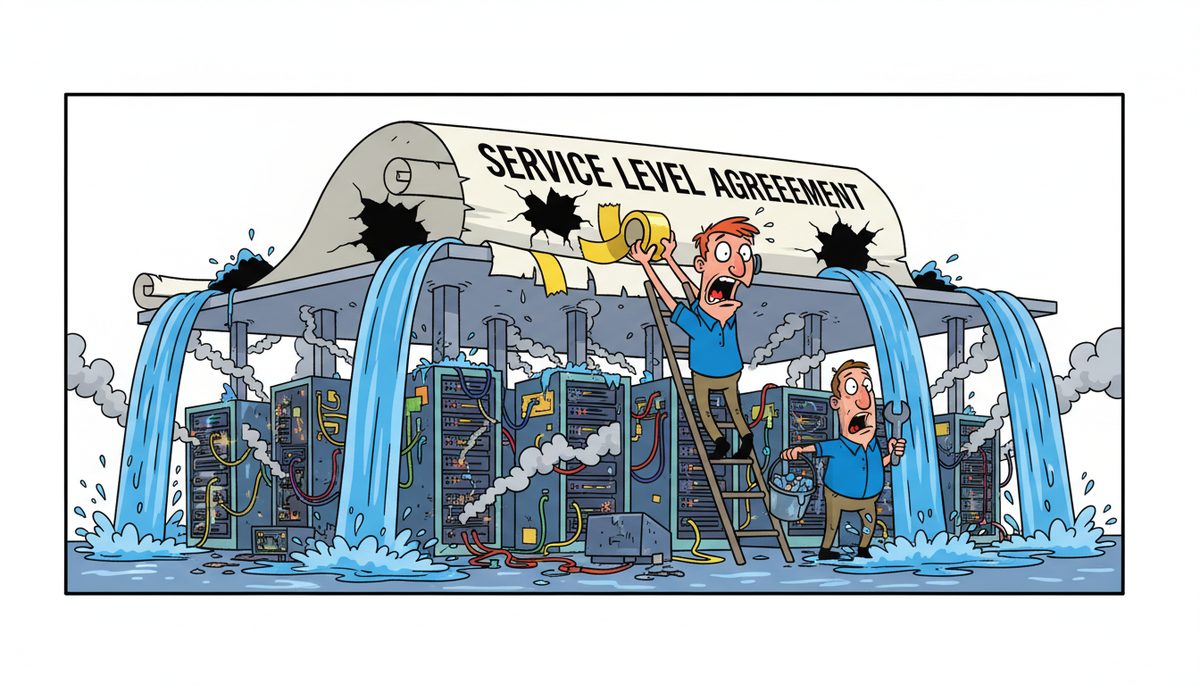
Your manufacturing IT service agreement should include guaranteed maximum response times for production emergencies (typically 15-60 minutes), explicit support for industrial systems like ERP, SCADA, and CNC networks, defined escalation procedures when remote fixes fail, data backup provisions meeting PIPEDA and BC PIPA requirements, and clear cost structures that prevent surprise charges during production downtime incidents.
Why Do Standard IT Contracts Leave Manufacturing Operations Vulnerable?
Most IT service agreements are written for office environments where a few hours of downtime means delayed emails. Your production line operates differently. When your ERP system crashes mid-shift or your SCADA network loses connectivity, every minute costs you machine time, labor hours, and shipment deadlines.
The villain here is the mismatch between generic IT contracts and manufacturing reality. Standard agreements promise “business hours support” or “next business day response” without acknowledging that your shop floor runs on different schedules. They don’t account for the specialized knowledge required to troubleshoot how your MES integrates with your CNC machines, or how your CAD/CAM workstations connect to your production scheduling system.
On Vancouver Island, this problem compounds. Generic contracts written by mainland providers don’t address ferry schedules or island geography. You’re left with agreements that technically promise support but practically leave you waiting hours for someone to arrive while your OEE numbers tank.
You feel helpless watching production stop, knowing every hour of downtime means explaining to customers why their orders are delayed and to ownership why expensive machines sit idle. It’s wrong because island manufacturers shouldn’t lose entire production shifts to IT problems that could be resolved quickly with the right contract provisions and local support structure.
What Happens When Your IT Contract Doesn’t Match Manufacturing Needs?
Without manufacturing-specific provisions, you face predictable failures. Your IT provider shows up during a production emergency and admits they don’t understand how your SCADA system connects to your PLCs. They can’t troubleshoot the network issue affecting your CNC machines because their contract doesn’t require industrial systems knowledge.
You miss critical shipment deadlines while technicians figure out your production environment. The contract you signed doesn’t penalize slow response times or failed resolutions, so there’s no incentive for urgency. Your work orders pile up, your production schedule falls apart, and you’re manually tracking everything because your ERP is down.
The financial impact is measurable. A single shift of lost production can cost thousands in machine time, labor, and missed delivery penalties. Over a year, inadequate IT support contracts cost manufacturers tens of thousands in preventable downtime.
Worse, generic contracts often lack proper data protection provisions for manufacturing. Your CAD files, production designs, and customer manufacturing data may not be backed up correctly or protected under PIPEDA and BC PIPA requirements. When a breach or data loss occurs, you discover your contract didn’t actually obligate your provider to protect your intellectual property.
What Response Time Commitments Should Manufacturing IT Contracts Include?
Your contract needs specific, measurable response time commitments tied to production impact. Look for guaranteed initial response times—the time between your call and when a qualified technician begins working on your problem. For production-critical issues, this should be 15-30 minutes maximum, not “within 4 hours” or “next business day.”
The contract should distinguish between response time and resolution time. Response time is when help starts; resolution time is when your system is working again. For production emergencies, your agreement should commit to remote troubleshooting beginning within minutes, with most issues resolved remotely within 30-60 minutes.
Critically, the contract must address what happens when remote resolution fails. You need automatic on-site dispatch provisions—not a separate service call request process. The agreement should specify maximum on-site arrival times based on your location. For Vancouver Island manufacturers, this means technicians stationed locally in Victoria, Nanaimo, or Duncan, not mainland providers who need to catch ferries.
Ernie, who runs a manufacturing operation, experienced this difference firsthand: “I can’t speak highly enough about the support we’ve received from DataStream. As someone who’s not very tech-savvy, dealing with IT issues used to feel like a huge challenge. But with DataStream, it’s a completely different experience. They’re incredibly quick to respond, and whenever something goes wrong, they step in and resolve the issue right away. I’ve had experiences with other IT services in the past, where we sometimes didn’t even get a call back the same day.”
The contrast between same-day response and previous providers who didn’t call back illustrates why response time provisions must be contractually binding, not aspirational.
Production downtime costs manufacturers an average of $260,000 per hour according to industry studies, making response time provisions the most financially significant contract terms.
Which Industrial Systems Should Your IT Agreement Explicitly Cover?
Your contract must explicitly list the manufacturing systems your IT provider will support. Generic language like “network support” or “server maintenance” doesn’t obligate them to understand your production environment.
Specify ERP system support by name—whether you run SAP, Oracle, Microsoft Dynamics, or industry-specific manufacturing ERP platforms. The contract should state whether the provider handles ERP troubleshooting, integration issues, and database performance problems or only the underlying servers.
Include SCADA and MES systems explicitly. These supervisory control and manufacturing execution systems are critical to production but require specialized knowledge. Your agreement should clarify whether the provider supports SCADA network connectivity, HMI workstation issues, and integration between your SCADA system and business networks.
List CAD/CAM workstation support, including the specific software packages your engineers use. CNC machine network connectivity should be explicitly covered, including how the provider handles network issues affecting machine uptime without disrupting active production runs.
For Vancouver Island manufacturers, the contract should address how the provider handles industrial IoT devices, production line sensors, and any cloud-connected manufacturing equipment. These systems often have unique security and connectivity requirements that standard IT contracts don’t acknowledge.
The agreement should also specify what the provider won’t support, so you’re not surprised when they decline to troubleshoot a critical system. Clear boundaries prevent mid-emergency debates about whether a problem falls under your contract.
What Data Protection and Compliance Provisions Do Manufacturing Contracts Need?
Your IT service agreement must address data protection under PIPEDA (federal) and BC PIPA (provincial) regulations. Manufacturing operations handle customer data, employee information, and proprietary production designs—all requiring legal protection.
The contract should specify backup frequency, retention periods, and recovery time objectives (RTO) for manufacturing data. Your production schedules, work orders, bill of materials, and CAD files need different backup treatment than office documents. Look for provisions requiring daily backups of production databases with recovery capabilities measured in hours, not days.
Include explicit data sovereignty clauses. Your manufacturing data should remain in Canada, stored on Canadian servers, to comply with privacy regulations and protect intellectual property. The contract should prohibit offshore data storage or access by technicians outside Canada without your explicit approval.
Security provisions should address industrial network segmentation. Your production network—where SCADA systems and CNC machines operate—should be separated from your business network. The IT agreement should specify how the provider maintains this segmentation while still supporting both environments.
For manufacturers serving US markets or handling export-controlled designs, the contract needs provisions addressing cross-border data handling and Canadian export control compliance. The Office of the Privacy Commissioner of Canada and the Office of the Information and Privacy Commissioner for BC provide guidance on these requirements.
Require regular security assessments and documented compliance reviews. Your agreement should obligate the provider to conduct periodic vulnerability assessments of your manufacturing systems and document compliance with relevant regulations.
How Should IT Contracts Handle Production Schedule Conflicts and After-Hours Support?
Manufacturing doesn’t stop at 5 PM. Your IT service agreement must align with your actual production schedule, not standard business hours.
Define your production hours explicitly in the contract. If you run two shifts, three shifts, or 24/7 operations, the agreement should provide equivalent IT support coverage. “After-hours support” shouldn’t mean reduced service—it should mean the same response times and expertise available during your production schedule.
The contract should address planned maintenance windows. IT providers need to perform updates, patches, and system maintenance, but not during your production runs. Your agreement should require advance notice of any planned downtime and limit maintenance to your scheduled production breaks or low-volume periods.
Include provisions for emergency maintenance that can’t wait for scheduled windows. The contract should specify how the provider will minimize production impact, whether through staged rollouts, redundant systems, or rapid rollback procedures if updates cause problems.
For Vancouver Island manufacturers, address holiday and weekend coverage explicitly. Island geography means you can’t rely on emergency technician availability during long weekends or holidays when ferry schedules are reduced. Your contract should either guarantee local technician availability or provide alternative support procedures for these periods.
The agreement should also protect you from maintenance-induced downtime. If a provider’s update or change causes production problems, the contract should specify their obligation to resolve it immediately without additional charges.
What Cost Structure and Billing Provisions Protect Manufacturing Operations?
IT service agreements use various pricing models. For manufacturing, you need cost structures that don’t penalize you for production emergencies or create financial surprises during downtime incidents.
Fixed monthly managed services pricing (typically $150–$225 per user per month for comprehensive coverage) provides predictable costs and unlimited support calls. This model works well for manufacturers because production emergencies don’t trigger additional charges. You can call for help during a SCADA network failure without calculating hourly technician costs while your line is down.
If your contract includes per-incident or hourly billing components, scrutinize the definitions. What constitutes a separate incident versus ongoing support for a single problem? If a server issue affects both your ERP and your production scheduling system, is that one incident or two? Ambiguous language leads to billing disputes during stressful downtime situations.
Look for provisions capping emergency service charges. Some contracts allow providers to charge premium rates for after-hours or emergency support. For manufacturers running multiple shifts, this effectively penalizes you for your production schedule. Your agreement should provide consistent pricing regardless of when you need help.
The contract should specify what’s included versus what costs extra. Are software licenses included? Hardware replacement? Network equipment upgrades? Travel time for on-site visits? For island manufacturers, clarify whether ferry costs or travel time from mainland locations add to your bill.
Include provisions for cost predictability during major incidents. If a server failure requires extensive recovery work, you need to know whether you’re facing unlimited hourly charges or whether the incident falls under your managed services agreement.
How Does Local IT Support Change Contract Requirements for Island Manufacturers?
You’ve recognized that generic IT contracts don’t match manufacturing reality. The gap between what standard agreements promise and what your production floor needs creates risk—missed deadlines, extended downtime, and preventable losses.
You know what it feels like when your ERP system goes down mid-shift and you’re scrambling to track work orders manually while your production schedule falls apart. You understand the panic when your CNC machines lose network connectivity and you’re facing a missed shipment deadline with no idea when IT support will actually arrive. You’ve experienced how island manufacturers get stuck waiting for mainland technicians to catch the ferry while your shop floor sits idle and machine uptime numbers tank.
Local providers who understand manufacturing systems and island geography can meet response time commitments that mainland companies can’t. When technicians are stationed in Victoria, Nanaimo, Duncan, and Cobble Hill, your contract can require same-day on-site support without ferry delays. When you call and reach live people immediately—no voicemail, phone tree, or long wait times—most problems get fixed remotely within minutes.
This local structure changes what your IT service agreement should contain. You can require response times that would be impossible with mainland providers. You can insist on same-day on-site support because technicians don’t need to plan around ferry schedules. Your contract can hold providers accountable to manufacturing-specific SLAs because the support infrastructure exists to meet them.
What Does a Manufacturing-Ready IT Service Agreement Look Like?
- Call a local IT provider who understands manufacturing systems and review your current agreement to identify gaps in response times, industrial system coverage, and production schedule alignment—talk to a real technician who can explain what provisions your specific ERP, SCADA, and CNC environment requires.
- Request a manufacturing-specific service agreement that explicitly lists your industrial systems, guarantees response times under 30 minutes for production emergencies, includes automatic on-site dispatch from island locations, and provides fixed monthly pricing that covers unlimited support calls during your production schedule.
- Implement the agreement with documented escalation procedures, test the response process with a non-emergency issue to verify the provider meets their commitments, and schedule quarterly reviews to ensure the contract continues matching your production needs as your manufacturing operation grows.
What Does Success Look Like for Your Manufacturing Operation?
With the right IT service agreement provisions, your production lines keep running because technology problems get fixed in minutes, not hours. Your shipment schedules stay on track because IT emergencies don’t turn into extended downtime waiting for ferry schedules or providers who don’t understand SCADA systems.
You meet delivery deadlines consistently. Your customers receive their orders on time because your ERP system, production scheduling, and CNC networks have reliable support backing them. Your OEE numbers improve because technology issues get resolved before they significantly impact machine uptime.
Your production data, CAD files, and manufacturing designs stay protected with backup systems and security that meet PIPEDA and BC PIPA requirements. You sleep better knowing your intellectual property and customer data are contractually protected, not just verbally promised.
You spend less time managing IT crises and more time managing production. Your shop floor operates smoothly because your IT service agreement actually matches your manufacturing reality.
If your current IT contract leaves you vulnerable during production emergencies or doesn’t address the industrial systems your manufacturing operation depends on, call a local provider who understands manufacturing to review your agreement and identify the provisions that protect your production schedule.
Or explore managed IT services approaches to see how comprehensive support agreements eliminate surprise charges and provide predictable costs for manufacturers.
Frequently Asked Questions
Should my IT service agreement include penalties for missed response times?
Yes, manufacturing IT contracts should include service level agreement (SLA) credits or penalties when providers miss guaranteed response times. These provisions ensure accountability during production emergencies. Look for contracts that refund a percentage of monthly fees or provide service credits when response commitments aren’t met, giving providers financial incentive to prioritize your manufacturing downtime situations appropriately.
How do I know if my IT provider actually understands manufacturing systems?
Ask specific questions about your ERP platform, SCADA network architecture, and CNC machine connectivity during contract discussions. A qualified provider will discuss how they segment industrial networks from business systems, handle MES integration issues, and troubleshoot production database performance. Request references from other manufacturing clients and ask about their experience with production-critical support incidents requiring industrial systems knowledge.
What should my IT contract say about supporting legacy manufacturing equipment?
Your agreement should explicitly address legacy system support, including older CNC controllers, proprietary SCADA platforms, and manufacturing equipment running outdated operating systems. The contract should specify whether the provider will maintain network connectivity and basic functionality for these systems or whether they’re excluded. Many manufacturers run critical production equipment that can’t be easily upgraded, requiring specialized support provisions.
Do I need separate IT agreements for my production network versus my office network?
Not necessarily, but your single agreement should explicitly differentiate between production and business network support with separate SLAs for each. Production network issues affecting manufacturing systems should trigger faster response times than office network problems. The contract should address how the provider maintains security segmentation between these environments while supporting both, ensuring production systems remain isolated from business network vulnerabilities.
How often should manufacturing IT service agreements be reviewed and updated?
Review your IT service agreement annually and whenever you add significant manufacturing systems or change production schedules. New ERP implementations, additional production lines, expanded shifts, or new facility locations all require contract updates. Schedule formal reviews quarterly to ensure response times, system coverage, and support hours still match your manufacturing operation’s current reality and growth trajectory.