Infrastructure as a Service (IaaS) lets you eliminate upfront server and storage hardware costs—typically $15,000–$50,000 per deployment—while converting fixed IT infrastructure into flexible monthly operating expenses that scale with your production demand. You gain remote access to computing resources, faster disaster recovery, and the ability to spin up test environments without purchasing physical equipment.
Why do traditional IT infrastructure investments hurt manufacturing cash flow?
When you purchase physical servers, storage arrays, and networking equipment for your ERP system or production data, you’re committing capital before you know whether next quarter’s orders will justify the expense. That $30,000 server sits in your facility whether you’re running two shifts or three.
The equipment depreciates on a fixed schedule while your production volume fluctuates with market demand. You’re paying for maximum capacity during slow periods and scrambling to add hardware during growth spurts.
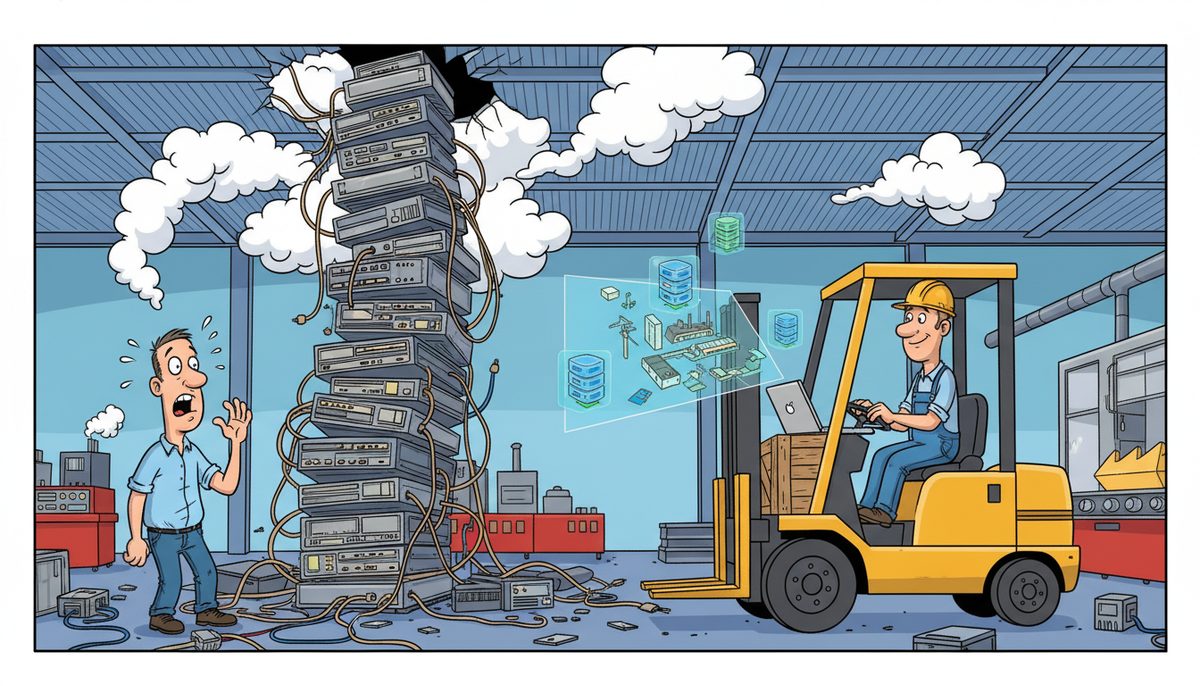
For Vancouver Island manufacturers, the problem compounds. When that server fails, you’re waiting for replacement parts to arrive by ferry or paying premium freight costs. Your production scheduling system goes down, your shop floor loses access to work orders, and you’re burning machine time while tracking everything manually.
The capital expense model forces you to choose between over-provisioning (wasting money on unused capacity) or under-provisioning (risking performance problems during peak production). Neither option aligns IT spending with actual manufacturing output.
How does IaaS eliminate upfront hardware costs for manufacturing systems?
IaaS moves your servers, storage, and networking infrastructure to cloud data centers. Instead of purchasing a physical server to run your ERP or MES software, you rent virtual machines and storage space on a monthly basis.
You deploy the exact computing resources your production systems need today—two virtual servers for your ERP database and application layer, 500GB of storage for CAD files, network bandwidth for shop floor connectivity. Next month, if you land a major contract, you add capacity in minutes without procurement delays or installation downtime.
The monthly operating expense model converts unpredictable capital projects into predictable line items. You know what IT infrastructure costs each month, and you adjust resources up or down as production demand changes.
For island manufacturers, IaaS eliminates the ferry delay problem entirely. Your infrastructure lives in geographically distributed data centers with redundant components. Hardware failures become the provider’s problem, not yours. Your production systems stay online while replacement hardware is swapped automatically.
IaaS also accelerates deployment timelines. Setting up a new production line with its own SCADA data collection? Spin up a new virtual server in hours instead of waiting weeks for hardware procurement, shipping to the island, and on-site installation.
What happens to your production data when island geography delays hardware replacement?
Your ERP server fails at 2 PM on a Tuesday. Your production schedule, inventory data, and work order system go offline. The shop floor switches to paper tracking while you wait for diagnosis.
The failed component needs replacement. If you’re running traditional infrastructure, that part ships from the mainland or further. Best case: next-day delivery if you pay premium freight. Realistic case: two to three days if the part isn’t in local stock. Your production line runs blind, your OEE numbers tank, and you’re explaining to customers why their shipment is delayed.
With IaaS, your virtual infrastructure fails over automatically to redundant hardware in the data center. Your production systems experience minutes of interruption instead of days. No ferry schedules, no freight costs, no scrambling to find compatible replacement parts for aging equipment.
The risk extends beyond single failures. Traditional infrastructure in your facility faces power outages, cooling failures, and physical damage. A small fire in your server room doesn’t just destroy hardware—it destroys your production data, CAD files, and customer order history if your backups live in the same location.
IaaS distributes your infrastructure across multiple data centers with redundant power, cooling, and network connectivity. Your manufacturing data exists in geographically separate locations, protected against local disasters that would cripple facility-based systems.
Vancouver Island manufacturers lose an average of $5,000–$15,000 per hour during unplanned ERP or production system downtime.
How does IaaS scale computing resources with production demand fluctuations?
Your production schedule doubles for Q4 holiday manufacturing. Your ERP system slows under the load of additional work orders, inventory transactions, and shop floor queries. Response times stretch from seconds to minutes, and production supervisors waste time waiting for screens to refresh.
With traditional infrastructure, you have two bad options: suffer through the slow performance, or purchase additional server capacity that sits idle for eight months of the year.
IaaS lets you scale computing resources to match production cycles. Add CPU cores and memory to your ERP virtual machines in October, run at higher capacity through December, then scale back down in January. You pay for the extra resources only during the months you need them.
The same flexibility applies to storage. Your CAD file library grows as engineering designs new products. Your SCADA systems accumulate machine performance data for quality control analysis. With IaaS, you add storage capacity as needed without purchasing and installing new storage arrays.
Seasonal manufacturers benefit most dramatically. Food processors ramping up for harvest season, boat builders scaling for summer production, or aerospace component manufacturers responding to contract awards all face the same challenge: production demand varies, but traditional IT infrastructure doesn’t.
IaaS also enables test environments that don’t require duplicate hardware. Need to test an ERP software upgrade before deploying to production? Clone your production environment in the cloud, run your tests, then delete the test servers when you’re done. No capital expense, no physical space consumed, no ongoing maintenance burden.
Can IaaS meet PIPEDA and BC PIPA requirements for manufacturing data?
Your manufacturing business handles employee data, customer information, and proprietary designs that fall under PIPEDA and BC PIPA regulations. You’re responsible for protecting that data regardless of where it’s stored.
IaaS providers offer data residency controls that keep your information within Canadian borders, meeting regulatory requirements. You specify that your virtual machines and storage remain in Canadian data centers, ensuring compliance with federal and provincial privacy laws.
The infrastructure includes encryption for data at rest and in transit. Your CAD files, customer orders, and production data move between your facility and cloud infrastructure over encrypted connections. Storage systems encrypt data automatically, protecting against physical theft of storage devices.
For manufacturers serving US markets, IaaS enables geographic separation of data. Keep Canadian customer data in Canadian infrastructure, US customer data in US infrastructure, and maintain the audit trails required for cross-border commerce.
WorkSafeBC requirements for technology in industrial environments still apply to your shop floor systems. IaaS doesn’t change your responsibility to maintain safe HMI interfaces or properly networked industrial equipment. But it does centralize your data protection, backup, and disaster recovery in infrastructure designed specifically for business-critical systems.
The challenge for island manufacturers is finding IT support that understands both IaaS architecture and manufacturing systems. Your production systems connect shop floor equipment to cloud infrastructure, creating hybrid environments that require specialized knowledge.
How does a local IT guide help manufacturers implement IaaS without disrupting production?
You know what it feels like when your ERP system goes down mid-shift and you’re scrambling to track work orders manually while your production schedule falls apart. You’ve experienced how island manufacturers get stuck waiting for mainland technicians to catch the ferry while your shop floor sits idle and machine uptime numbers tank.
Since 2012, DataStream Networks has supported Vancouver Island manufacturers with local technicians in Victoria, Nanaimo, Duncan, and Cobble Hill. When you call, live people answer immediately—no voicemail, no phone trees, no waiting to explain your production emergency to someone who doesn’t understand SCADA systems or industrial networks.
Marjorie Reid experienced this approach during a data recovery process: “What really set them apart was their transparency and the way they explained everything during our data recovery process. They took the time to walk us through all the available options, including any financial impacts, in a clear and understandable way, making sure we felt comfortable with the decisions we were making.”
That same transparency applies to IaaS implementation for your manufacturing business. Your current ERP, MES, and SCADA systems get assessed to identify which components benefit from cloud infrastructure, and you receive a migration plan that doesn’t shut down your production line.
Most problems get fixed remotely within minutes. When on-site work is required, technicians dispatch automatically from Vancouver Island locations—no ferry delays, no mainland travel time, no explaining your shop floor layout to someone who’s never seen your facility.
The managed IT services include ongoing support for hybrid manufacturing environments where shop floor systems connect to cloud infrastructure. You get the cost advantages of IaaS without losing the immediate response times island manufacturers require.
What’s the practical process for moving manufacturing systems to IaaS?
- Call (250) 929-0745 to talk to a real technician who understands manufacturing systems—your current ERP, MES, and production data infrastructure gets assessed, systems that benefit from IaaS are identified, and you receive a migration timeline that protects your production schedule.
- Your cloud infrastructure gets implemented in stages, starting with non-critical systems, then moving production workloads during planned maintenance windows with full rollback capability if issues arise.
- You gain ongoing support from local Vancouver Island technicians who monitor your hybrid environment, optimize resource allocation as production demand changes, and dispatch automatically to your facility when shop floor systems need on-site attention.
What does manufacturing success look like with IaaS?
Your production line keeps running because IT infrastructure failures resolve automatically in minutes instead of waiting days for replacement hardware to arrive on the island. Your ERP and MES systems scale computing resources to match production demand, eliminating slow performance during peak periods and wasted capacity during slow months.
You meet shipment deadlines consistently because your production data, scheduling systems, and shop floor connectivity don’t depend on aging physical servers in your facility. Your capital budget focuses on production equipment and tooling instead of IT hardware that depreciates while sitting in a server room.
Your production data stays protected with geographically distributed backups that meet PIPEDA and BC PIPA requirements. When you need to test ERP upgrades or deploy new production systems, you spin up cloud resources in hours instead of waiting weeks for hardware procurement and installation.
You reach real local technicians immediately when production systems need attention, and most issues resolve remotely within minutes. When on-site work is required, Vancouver Island technicians dispatch without ferry delays or mainland travel time.
Whether you’re running operations in Victoria, Duncan, or Nanaimo, IaaS converts unpredictable IT infrastructure costs into flexible monthly expenses that align with your actual manufacturing output.
Call (250) 929-0745 to talk to a real technician now about moving your manufacturing systems to infrastructure that scales with production demand and eliminates hardware replacement delays.
Frequently asked questions
What’s the typical monthly cost of IaaS for a small manufacturing business?
IaaS costs depend on computing resources, storage capacity, and bandwidth requirements. A small manufacturer running ERP and basic production systems typically spends $500–$2,000 monthly for virtual servers and storage, replacing $20,000–$40,000 in upfront hardware purchases. Costs scale with production demand, and you add or remove resources as needed without capital expenses.
Can IaaS support real-time SCADA and MES systems for shop floor operations?
Yes, modern IaaS provides the low-latency network connectivity required for real-time manufacturing systems. Your shop floor equipment connects to cloud-hosted SCADA and MES applications with response times suitable for production monitoring and control. Hybrid architectures keep time-critical control loops local while moving data storage and analytics to cloud infrastructure for scalability and disaster recovery.
How long does it take to migrate existing ERP systems to IaaS?
Migration timelines range from two weeks to two months depending on system complexity and data volume. Simple ERP deployments with clean databases migrate in days. Complex systems with custom integrations, extensive historical data, or multiple production locations require phased migrations with testing at each stage. Most manufacturers complete migration during planned maintenance windows to avoid production disruption.
What happens to our production data if the IaaS provider experiences an outage?
Reputable IaaS providers architect infrastructure with redundancy across multiple data centers. If one facility experiences outages, your virtual machines and data fail over automatically to backup locations. Your production systems experience minutes of interruption instead of extended downtime. This geographic distribution provides better disaster recovery than single-facility server rooms where local power outages or equipment failures stop all operations.
Do we still need local IT support if our infrastructure moves to IaaS?
Yes, you need local support that understands both cloud infrastructure and manufacturing systems. Your shop floor equipment, network connectivity, and industrial systems remain on-site and require technicians who can respond quickly to physical issues. IaaS eliminates server hardware maintenance but doesn’t replace the need for immediate response when HMI terminals fail, network switches lose connectivity, or CNC machines can’t reach production databases.